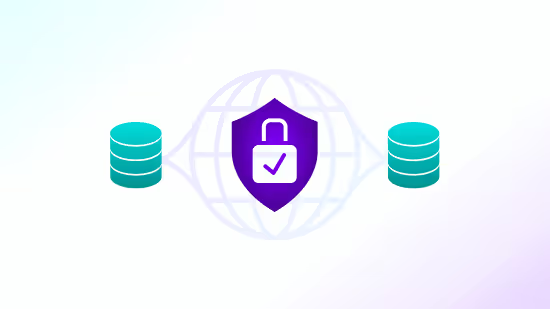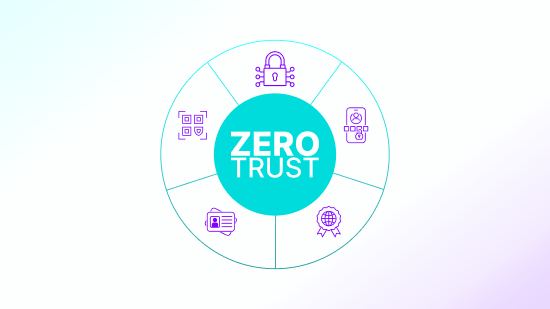
Zero Trust is a cybersecurity framework built on the principle that no user, device, or network segment should be trusted by default. Unlike traditional perimeter-based security that assumes everything inside the firewall is safe, Zero Trust implementation requires continuous verification of every access request—whether it originates from a VPN, cloud service, or internal segment. When it comes to data access, this means implementing least-privilege controls at every layer: query time, data-at-rest, and in transit.
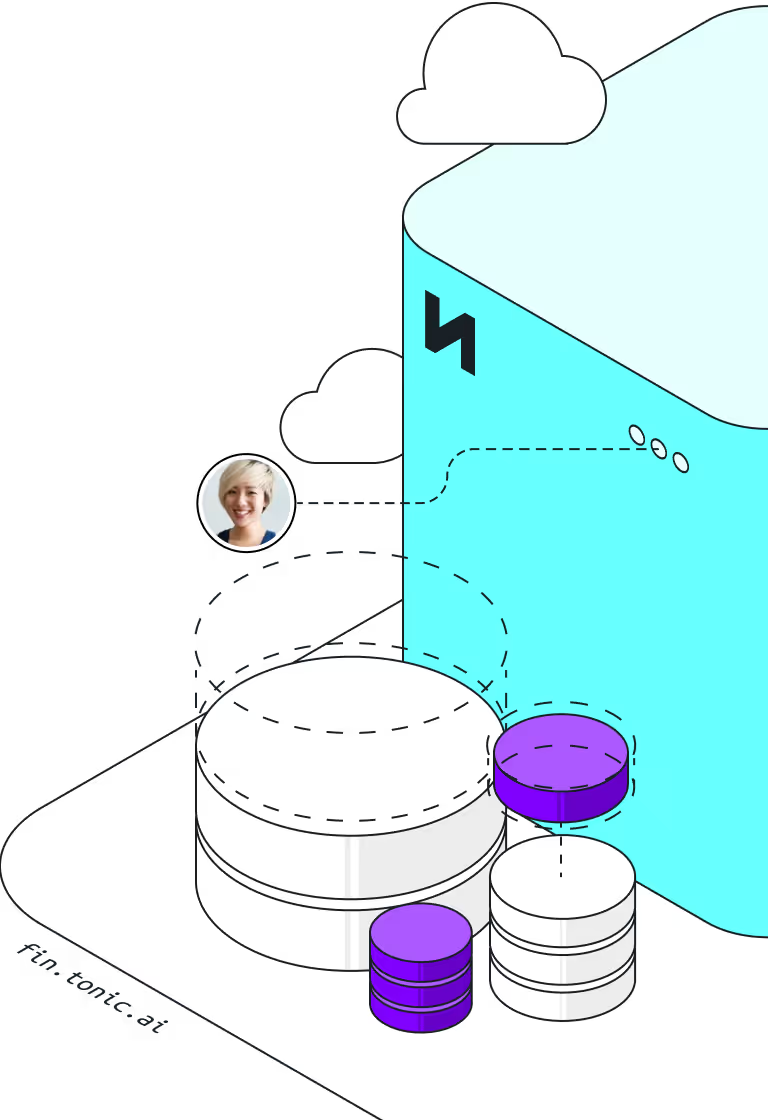
Data masking and synthetic data generation enforce Zero Trust at the data layer. Data masking transforms production values into realistic placeholders on-the-fly, while synthetic data generation produces entirely fictitious records that preserve statistical properties. Together, they reduce exposure of sensitive data and uphold the "never trust, always verify" mandate.
What is Zero Trust?
Zero Trust treats every user, device, and network segment as untrusted until proven otherwise. It shifts your security focus from defending a perimeter to continuously verifying all access paths.
No assumed trust
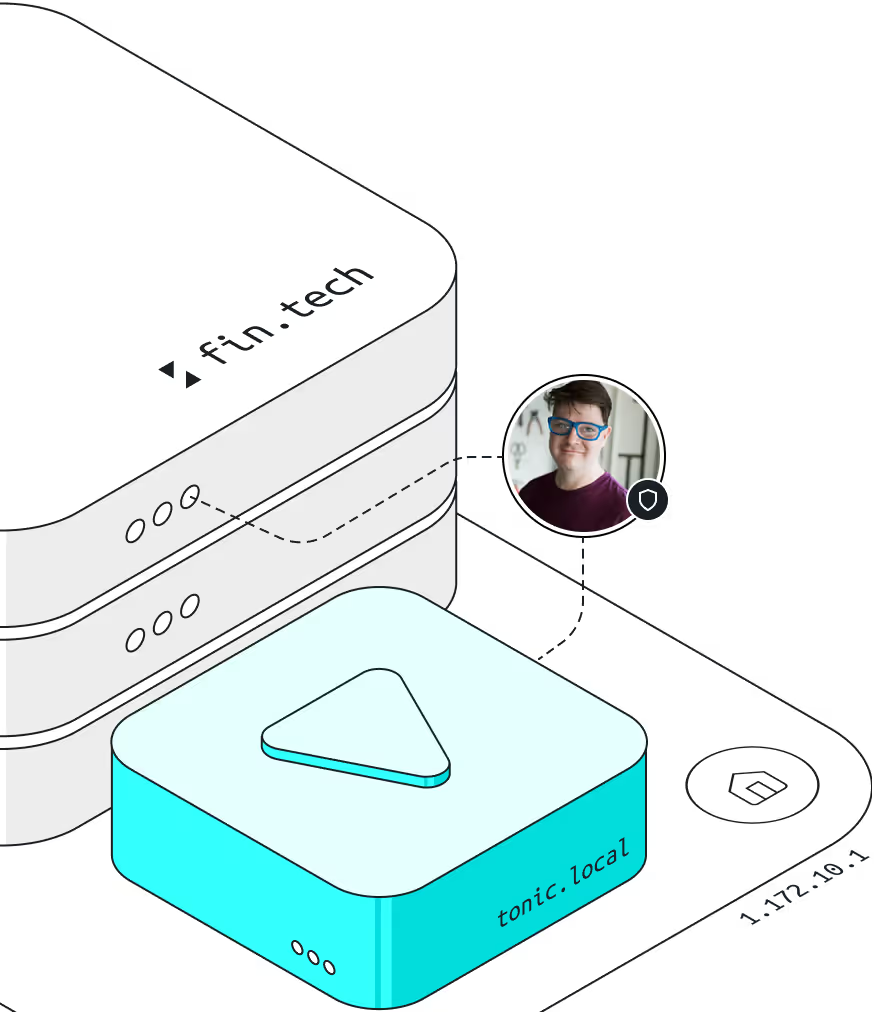
Zero Trust rejects the traditional perimeter model where users inside the network are implicitly trusted. Every request—whether from VPN, cloud service, or local segment—requires authentication and authorization based on the current context. This means an attacker who compromised a laptop or stole credentials can't move laterally through your network simply because the attack originated from inside your firewall.
Comprehensive security
Zero Trust spans identity, devices, applications, network traffic, and data. You apply consistent policy enforcement across on-premises, cloud, and hybrid deployments so no segment becomes a backdoor for attackers.
Continuous monitoring
Instead of one-time checks, Zero Trust implementation relies on real-time telemetry—identity logs, device posture, network flows, and data access patterns—to detect anomalies. You adapt access rights dynamically, revoking or escalating trust as conditions change. For example, if a developer's account suddenly requests database exports at 3 AM from an unfamiliar location, continuous monitoring flags and blocks the activity before data leaves your network.
Core principles of Zero Trust
Zero Trust rests on three interconnected principles that transform how you think about security.
- Verify every identity and device before granting access.
- Minimize the impact when a breach happens.
- Automate context collection for rapid response.
These principles work together to shrink your attack surface while accelerating threat detection, turning security from a static checkpoint into a dynamic defense system.
1. Continuously verify
Traditional security verifies identity once—when users log in—then trusts them until they log out. Zero Trust flips this model: you verify identities, device posture, and application integrity at each access request, treating every interaction as potentially hostile. Multi-factor authentication and endpoint detection tools force even authorized users to prove their identity on every login, and continuous verification extends to API calls and data queries, triggering reauthentication or additional risk checks when unusual patterns emerge.
This constant validation means a stolen session token or hijacked API key can't persist long enough to cause real damage—the system challenges suspicious activity immediately rather than discovering it weeks later in logs.
Limit "blast radius"
When an attacker breaches your perimeter—and they will eventually—the question becomes how far they can move before you stop them. You segment networks, micro-segment workloads, and scope data permissions so a compromised credential or device can't pivot laterally across your infrastructure. By restricting query-level access and returning masked or synthetic data when possible, you reduce what attackers can steal or misuse even if they successfully authenticate.
Automate context collection/response
Manual security review can't keep pace with the velocity of modern threats—by the time someone notices anomalous behavior in yesterday's logs, attackers have already exfiltrated data or established persistence. Use ingest logs from identity providers, SIEMs, endpoint agents, and database proxies to build a real-time picture of risk, then let automated playbooks adjust policies or quarantine sessions when thresholds are exceeded.
For data access specifically, you can automate masking policies based on user role or environment, eliminating the manual configuration errors that create backdoors. Automation transforms security from a reactive process—investigating breaches after they happen—into a proactive defense that adapts faster than human operators could manage.
Why data masking & data synthesis are essential for Zero Trust implementation
Zero Trust assumes every environment outside production is potentially compromised—which means raw customer data has no business living in development laptops, staging servers, or third-party analytics platforms.
You need two complementary strategies to enforce this principle at the data layer:
- Masking production data when teams need realistic formats and relationships that preserve existing business logic.
- Synthesizing entirely new datasets when production data is too sensitive to use even in masked form.
Both approaches reduce your exposure to breaches while maintaining the data utility your teams depend on for effective testing and development.
Data masking for Zero Trust
Data masking transforms sensitive values into realistic placeholders while preserving the structure and relationships that make the data useful. In Zero Trust implementation, masking enforces least-privilege access at the data layer—users see only what they need, in a form that protects the original values. For example, a developer testing a payment flow needs credit card numbers that pass format validation, but they don't need real card numbers that could be stolen if their laptop is compromised. Similarly, a QA engineer verifying address formatting logic needs realistic addresses, but those addresses shouldn't map back to actual customer locations.
The key is maintaining referential integrity across tables while transforming sensitive fields. If a user_id appears in customers, orders, and support_tickets tables, masking must apply the same transformation consistently so your integration tests don't break on foreign key violations.
For structured data, tools like Tonic Structural automate this process, letting you define per-column rules that map to your risk classifications. For unstructured content—logs, support tickets, chat transcripts—you need entity detection from Tonic Textual that identifies user IDs, account numbers, and other PII embedded in free text, then applies masking policies consistently across all instances.
Data synthesis for Zero Trust
Synthetic data often takes a different approach: instead of transforming production records, you generate entirely new ones that mimic production's statistical properties without referencing real individuals. This is critical for Zero Trust scenarios where even masked production data carries residual risk—offshore development teams, third-party analytics partners, or ML model training where data might be logged or cached in ways you can't fully control.
The advantage of synthesis is complete decoupling from production. There's no transformation key to protect, no residual patterns that clever attackers might exploit, and no compliance concerns about whether your de-identification meets regulatory standards for irreversibility. A synthetic customer record with the name "Maria Garcia," email "mgarcia47@example.com," and order history totaling $2,847 exists only in your test database—it's not a transformed version of a real Maria Garcia whose data could theoretically be reconstructed.
Synthesis excels in several specific scenarios:
When building new features before production data exists, you can use tools like Tonic Fabricate to generate realistic datasets from schema definitions alone—describe the relationships and distributions you need, and generate thousands of records that behave like real data without waiting for actual customers.
When training ML models, synthetic data lets you oversample rare but important cases: if fraud represents 0.1% of production transactions, synthesize additional fraud examples to improve model detection without exposing real fraud patterns that criminals could study.
When sharing data with external vendors for analytics or integration testing, synthetic datasets eliminate the legal complexity and breach risk of even masked production data crossing organizational boundaries.
How Tonic.ai supports the benefits of Zero Trust
Zero Trust implementation pays off: when breaches inevitably happen, attackers find data that leads nowhere. A stolen database of synthetic customer records, de-identified transaction histories, and synthetic support tickets contains nothing to monetize, no credentials to exploit, and no personal information to weaponize. You've eliminated the crown jewels from untrusted environments entirely.
Tonic Structural de-identifies structured and semi-structured data while preserving referential integrity across tables, applying format-preserving encryption, consistent tokenization, and realistic substitutes based on your risk classifications.
Tonic Textual detects and transforms PII in unstructured data using proprietary Named Entity Recognition models, ensuring that logs, support tickets, and knowledge bases remain compliant with privacy regulations like HIPAA and GDPR.
Tonic Fabricate generates fully synthetic datasets, letting you describe requirements in natural language and iterate to production-like data without referencing real records.
These capabilities work together to build Zero Trust data pipelines:
- Continuous verification at the data layer: automated masking and synthesis policies enforce least-privilege access based on user role and environment
- Limited blast radius: even if attackers compromise non-production systems, they find only de-identified or synthetic data with no path back to real customer information
- Automated context collection: governance controls including versioning, reproducibility logs, and privacy reports provide audit trails that demonstrate compliance and support incident response
Whether you're provisioning test databases for CI/CD pipelines, training ML models on sensitive data, or sharing datasets with external partners, Tonic.ai supports scalable, compliant development while enforcing Zero Trust principles at every access point.
Try Tonic.ai for stronger security
By integrating Tonic.ai into your Zero Trust architecture, you enforce data-layer security that assumes breach and limits exposure—keeping sensitive information out of untrusted environments while preserving the realism your teams need for effective development and testing. The result is faster, safer innovation that aligns security controls with the way modern teams actually work.
Ready to see how Tonic.ai strengthens your Zero Trust strategy? Book a demo to discover how de-identification and synthesis protect your data without slowing down development.

A bilingual wordsmith dedicated to the art of engineering with words, Chiara has over a decade of experience supporting corporate communications at multi-national companies. She once translated for the Pope; it has more overlap with translating for developers than you might think.