How synthetic data can help solve AI’s data crisis


Artificial intelligence development faces a fundamental bottleneck: the widening gap between demand for high-quality training data and its availability. Gartner predicts that by 2028, 33% of enterprise software applications will incorporate agentic AI capabilities, which require copious amounts of data to function properly.
As AI systems grow more sophisticated, they will require larger, more diverse datasets—yet production data remains locked behind privacy regulations, scattered across inaccessible silos, or simply insufficient for emerging use cases. Synthetic data—artificially generated records that mimic the statistical properties of real-world datasets—offers a path forward. Rather than waiting months for privacy reviews or accepting the limitations of sparse production records, teams can generate unlimited realistic datasets on demand without exposing sensitive information.
For data scientists and engineering leaders, synthetic data is the primary fuel for AI innovation, enabling faster iteration while meeting privacy and compliance requirements.
What is the AI data crisis?
The AI data crisis describes the compounding challenges teams face when trying to source adequate training data for modern machine learning systems. As organizations scale AI initiatives beyond pilot projects, four interconnected problems slow development and compromise model quality.
Running out of real data
AI models, and LLMs in particular, have already trained on the vast majority of publicly available data. The training data that they haven’t fully tapped into yet? Proprietary data. Companies and organizations sit on vast hoards of real-world data that is highly valuable for model training, given its realism, variety, and domain-specific nature. But privacy risks and compliance violations rightfully stand in the way of teams leveraging these datasets for model training purposes.
These teams are struggling with data scarcity as a result. The models can only get so far on public data, but proprietary data is off-limits. The AI data crisis, therefore, is fundamentally a crisis of access: the data needed to advance AI exists, but it is locked behind a barrier of privacy compliance that standard scraping cannot cross.
Model collapse
Reusing the same dataset across successive training cycles introduces subtle but devastating problems. Model collapse occurs when neural networks overfit to specific patterns in limited training data, losing their ability to generalize to new inputs. The model memorizes rather than learns, producing high accuracy on test sets but catastrophic failures in production.
Training leakage—the accidental inclusion of information from test sets or future data—creates even more insidious issues. Your validation metrics look excellent because the model has already "seen" the answers, but those inflated performance numbers collapse when the system encounters genuinely novel data. Without fresh, varied datasets, you're building AI systems on quicksand: they appear stable until real-world conditions expose their fundamental brittleness.
Poor data hygiene
Data quality issues consume enormous engineering resources. Incomplete records where critical fields contain NULL values force you to either discard samples or impute missing data, both of which degrade model performance. Inconsistent formatting requires extensive preprocessing before training can even begin.
Unaddressed outliers present another dilemma: are they measurement errors that should be removed, or rare edge cases your model must learn to handle? Poor data hygiene doesn't just slow projects; it fundamentally limits how sophisticated your models can become.
Regulatory restrictions
Privacy regulations like GDPR and CCPA constrain what data you can use and how. Accessing production databases requires lengthy approval processes, documented data processing agreements, and ongoing compliance auditing.
These restrictions hit hardest when you need data most:
- Building models for new markets where you haven't yet established data collection pipelines
- Training systems for rare events where production samples are inherently limited
- Collaborating with external partners who can't access your production systems.
How synthetic data helps
Synthetic data for AI bridges the gap by providing realistic, fully artificial datasets for model training workflows. You can generate unlimited records, preserve schema relationships, and control statistical distributions—all without touching real personal data.
Speeding up model development
By using synthetic data for AI, you skip manual data collection and lengthy privacy reviews. Instead of waiting for weeks to secure production datasets, you can spin up synthetic datasets on demand. That agility lets you prototype model architectures, run hyperparameter sweeps, and validate performance in parallel.
Addressing privacy and regulatory concerns
Synthetic records contain no real personal identifiers, substantially reducing the privacy risks associated with using production data for AI training. When properly generated, synthetic data for AI creates separation between training datasets and actual individuals—you're working with artificial records that exhibit realistic statistical properties rather than information tied to real people.
Reducing bias in data sets
Production data can reflect historical biases: underrepresented demographics, skewed geographic distributions, or systematic measurement errors. Synthetic data generation lets you correct these imbalances intentionally. If women represent only 30% of your production dataset, you can generate synthetic records to achieve 50-50 gender distribution without waiting years to collect more real data.
Filling data gaps
Synthetic data for AI is especially helpful when you need rare-event scenarios, edge cases, or transactional patterns absent from real logs. Tonic Fabricate can generate millions of customer journeys with specified churn rates, session lengths, or purchase behaviors. That means you can test and train models on corner cases that otherwise require expensive A/B tests or simulated environments.
Types of synthetic data used in AI model training
Different generation approaches serve different needs, balancing realism, privacy, and computational cost:
Rule-based data
Rule-based synthetic data applies deterministic transformations or templates. You define patterns—like date ranges, numeric formats, or custom regex rules—and generate data that follows those patterns. Use this for fields with clear business rules (e.g., ZIP codes, product SKUs).
Model-based data
Model-based synthetic data relies on probabilistic models—Gaussian mixtures, Bayesian networks, or generative adversarial networks (GANs)—to sample new records. These methods capture feature correlations and multi-modal distributions.
De-identified data
De-identification transforms production-derived data using consistent tokenization, format-preserving masks, and a variety of other techniques. Tonic Structural applies realistic de-identification for structured data, keeping referential integrity intact. Tonic Textual does the same for unstructured data, replacing sensitive values in free-text with context-aware tokens or synthetic substitutes.
Hybrid
Hybrid approaches blend rule-based, model-based, and de-identified techniques. For example, you might de-identify existing customer records for core tables, then use model-based methods to enrich purchase-detail tables with synthetic transactions. Tonic Structural offers a variety of algorithms to tailor data synthesis to the needs of specific data types, and Tonic Fabricate combines model-based and rule-based approaches in generating synthetic data for AI from scratch.
Hybrid workflows let you target privacy-sensitive columns with masking while enhancing other areas with full synthetic generation.
How to generate synthetic data for AI
You have several options for generating synthetic data for AI model training. Tonic.ai's suite covers structured and unstructured data, whether you need de-identification, from-scratch generation, or a mix.
Agentic data generation
Agentic generation is particularly useful when real data is sparse, heavily restricted, or biased toward historical behavior. By defining constraints explicitly—such as rare event frequency, boundary values, or cross-field dependencies—you can create datasets that stress-test model behavior in ways production data rarely allows.
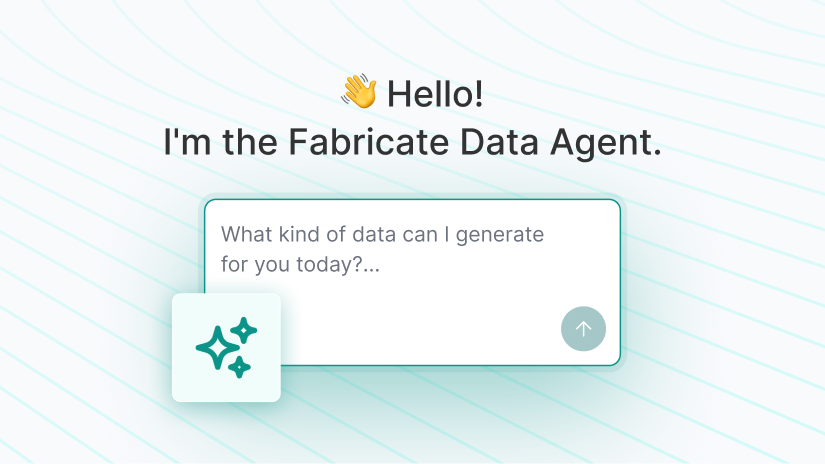
With Tonic Fabricate, you describe your schema or upload a data model, and its Data Agent handles the rest. The agent uses large language models and built-in generators to spin up high-fidelity synthetic tables. You can iterate in its chat UI—tune volumes, adjust class splits, or refine distributions—and export results as SQL, JSON, or any text file type.
Unstructured data synthesis
For AI teams working with language models, unstructured synthesis matters because meaning often lives outside structured fields. Preserving tone, intent, and conversational flow allows models to learn patterns that simple redaction would destroy.
Tonic Textual processes free-form text—support tickets, notes, logs—by detecting sensitive entities, redacting or tokenizing them, and synthesizing realistic replacements. Its proprietary NER models cover names, emails, IDs, and more, and you can train model-based custom entity types within the platform for domain-specific patterns. After transformation, validate utility by checking entity frequencies and context coherence, then run privacy audits to ensure no direct identifiers remain.
Structured data de-identification
Structured data de-identification works well when schema fidelity matters more than novelty. Models trained on these datasets benefit from realistic joins, cardinality ratios, and long-tail values that reflect operational systems. The auditability of the transformation process also supports internal reviews, compliance requirements, and repeatability across environments.
When you start from production tables, use Tonic Structural to apply referentially intact data de-identification. It identifies sensitive columns, applies format-preserving encryption (FPE) and consistent masking that maintains foreign-key integrity. The platform provides full audit logs for data governance. Validate by comparing relational graphs, distributions, and key cardinalities before using the dataset in model training workflows.
Hybrid
Hybrid approaches often deliver the best balance between realism and safety. They allow teams to preserve the structural backbone of real systems while expanding data volume, filling gaps, and introducing controlled variation. This makes hybrid pipelines well-suited for end-to-end AI development, from early experimentation through pre-production validation, without exposing sensitive information at any stage.
Combine Fabricate, Textual, and Structural for full synthetic data coverage. For example, de-identify your core customer table with Structural, synthesize customer interactions via Fabricate, and redact support transcripts through Textual. Hybrid workflows give you production-shaped schemas augmented with fresh synthetic records and safe unstructured text—all in one pipeline.
Why AI teams trust Tonic.ai
Synthetic data helps you overcome the AI data crisis by supplying unlimited, privacy-aligned datasets for model training. Tonic.ai supports your workflows at every stage:
- Fabricate's Data Agent lets you chat to generate synthetic datasets from scratch in minutes.
- Textual detects, redacts, and synthesizes unstructured text with configurable NER.
- Structural applies realistic de-identification while preserving schema relationships.
Teams across healthcare, finance, and e-commerce use Tonic.ai to accelerate AI model training, fill data gaps, and reduce bias without exposing real personal information.
Ready to see it in action? Book a demo with Tonic.ai and start generating the synthetic data you need for robust, production-ready AI models.
A bilingual wordsmith dedicated to the art of engineering with words, Chiara has over a decade of experience supporting corporate communications at multi-national companies. She once translated for the Pope; it has more overlap with translating for developers than you might think.