Tonic.ai vs Delphix: AI-native test data vs legacy virtualization
A capability-by-capability comparison of Tonic.ai and Delphix for enterprise test data: data source coverage, de-identification, synthetic data, subsetting, and AI-agent readiness.
Last updated July 2026
0 min read
.webp)


Tonic.ai is a modern, AI-native platform for enterprise test data, natively connecting to relational databases, NoSQL stores, and cloud warehouses to de-identify data and generate synthetic data on demand — compared to Delphix, which centers on virtualizing copies of production databases with optional masking layered on top. Both help large engineering teams get realistic data into lower environments, but they start from different premises about what the hard problem is.
AI has changed how software gets built. Coding assistants and agents have turbocharged development velocity, but test data hasn't kept pace; teams shipping faster than ever still wait on safe, realistic data to test against. AI-driven development needs an AI-driven test data solution, which is a key lens to use when comparing test data management tools across the broader market.
Delphix treats the problem as distribution: make many fast, cheap copies of production and hand them out. Tonic treats it as fitness for use: give every environment data that's safe, realistic, and shaped for the workload in front of it, whether that means using AI to de-identify the data you already have or to generate data that never existed. For enterprise engineering, platform, and AI teams in regulated and cloud-native organizations, that difference decides which tool fits.
If your environment runs on relational databases, NoSQL stores, and cloud warehouses, and you want AI-native workflows and minimized data liability at scale, Tonic.ai is the stronger fit. Delphix remains capable for legacy-heavy environments built around full-copy virtualization, a use case that is arguably fading.
Both platforms at a glance
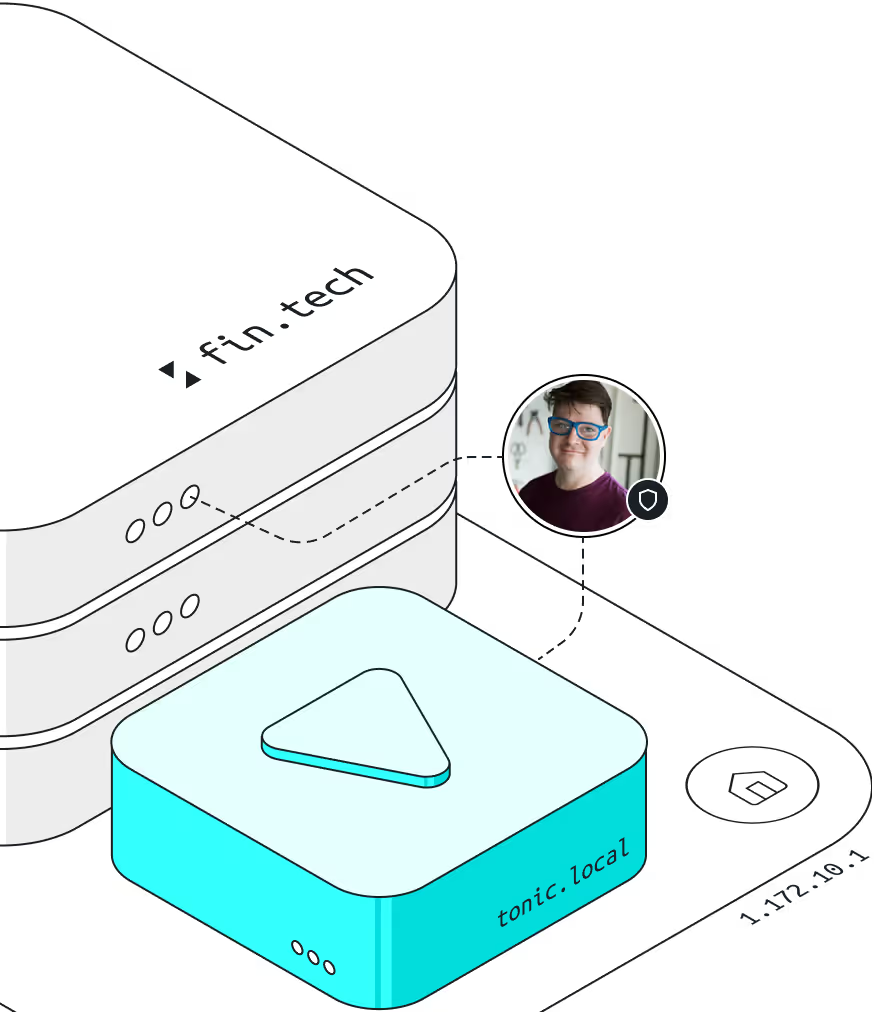
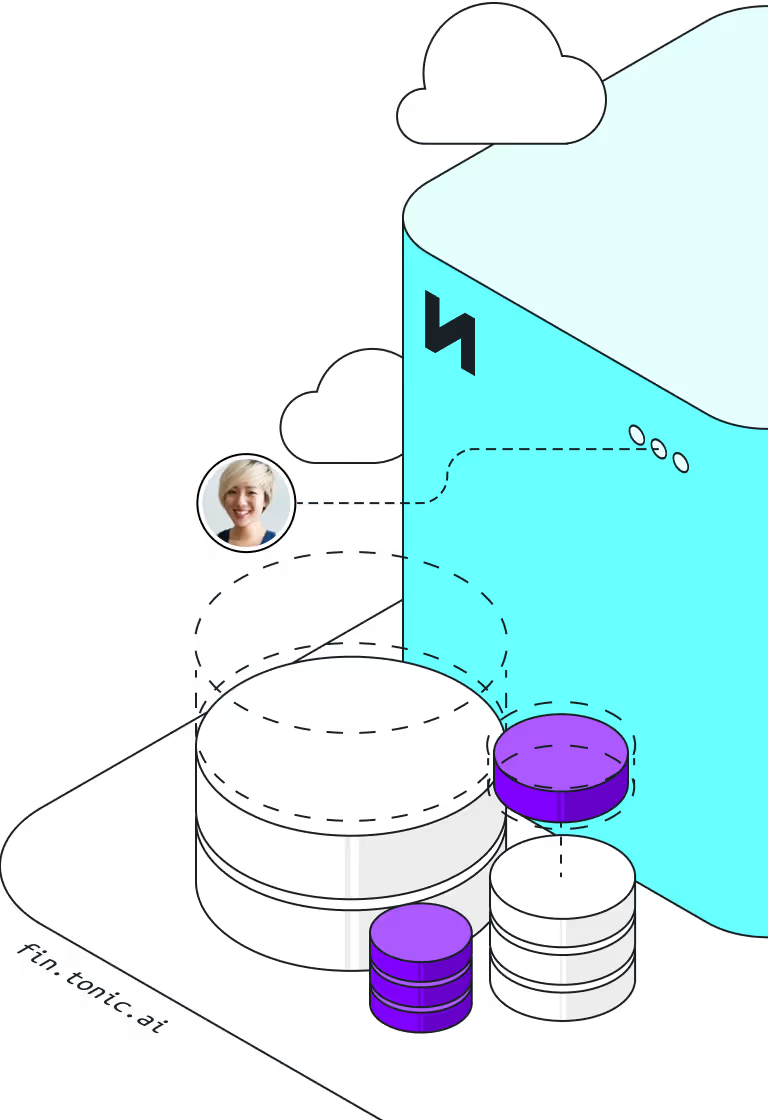
Delphix and Tonic overlap on the goal — safe, fast data for non-production environments — and diverge on architecture.
Comparing Tonic.ai and Delphix for enterprise test data
The two platforms diverge across the capabilities that matter most to an enterprise test data buyer. Here's the at-a-glance summary, followed by a closer look at key areas of functionality.
| Criterion | Tonic.ai | Delphix |
|---|---|---|
| AI-native & agent-ready | Built-in AI workflows, including the Structural Agent, Fabricate Data + Validation agents, and Fabricate MCP server for in-tool generation. | AI-agent-consumption tooling is more limited, though it does offer an MCP. |
| Data source & environment coverage | Native connectors across leading relational, NoSQL, warehouses, and lakehouses (including Snowflake and Databricks), files, Salesforce. | Focused on legacy and traditional RDBMS; Snowflake/Databricks limited to manual masking templates. |
| Referential integrity & cross-database consistency | Consistency within and across databases of different types; patented database subsetter. | Deterministic masking for consistency on supported systems. |
| Sensitive data discovery | Pattern-based + LLM-enhanced detection (~50% more PII caught) + custom entities. | Automated discovery on supported sources. |
| Data masking & de-identification | Core capability across all supported sources; masking, tokenization, generalization, FPE; org-level custom presets. | Masking via prebuilt algorithms, but a separate step; masked-VDB provisioning limited to Oracle, SQL Server, Sybase. |
| Synthetic data generation | AI-agent generation of coherent relational databases, JSON, free-text, and mock APIs from scratch or modeled from existing data at scale. | Limited and not yet available at enterprise scale; teams often supplement with a separate tool. |
| Subsetting & isolated environments | Patented subsetter creates targeted, referentially intact subsets per developer; on-demand API refresh. | No subsetting capabilities; limited to virtual copies (Copy-on-Write) of full production databases. |
| Data governance & reporting | RBAC, workspace sharing, privacy reports, audit trails; org-level privacy-policy presets. | Governance and compliance reporting on supported sources. |

AI-native and agent-ready workflows
Tonic is built for AI-driven and agent-driven development, through the built-in agents for test data configuration, transformation, and generation, as well as MCP servers for generating data directly within the tools where today's developers work.
- The Structural Agent is a chat-based, schema-aware assistant that takes action, not just answers questions. It configures generators and subsetting, populates custom data types, and enforces compliance requirements directly, compressing configuration — roughly 80% of the work in a test data project — from hours to minutes. It operates within existing permissions, and its actions are logged for auditability.
- Fabricate's agents work as a pair: the Data Agent generates synthetic data that's referentially intact from a prompt, a schema, or a sample, and the Validation Agent reviews and refines the output in a loop, holding quality even from an imprecise prompt.
- The Fabricate MCP server connects any MCP-compatible client — Claude, Cursor, or VS Code — so developers generate data in plain language from inside the tools they already work in, then pull the finished datasets back without leaving their workflow.
When Boomi set out to build agentic AI workflows, it gave 2,000 employees secure access to a synthetic Snowflake environment built with Tonic.ai. The team ran a proof of concept in under six weeks, launched its first database in two days, and moved prototypes to production simply by swapping the Snowflake URL — flipping a switch, as their director of data engineering put it.
Delphix has more recently added AI to its platform, but its capabilities are narrower and newer, centered solely on synthetic data generation rather than agents that act across discovery, configuration, de-identification, generation, and provisioning.
Data source and environment coverage
Tonic connects natively to the modern enterprise data environment, including cloud warehouses, while Delphix's deepest capability, full virtualization, centers on traditional relational databases.
Tonic.ai's native connectors span leading relational databases, NoSQL stores, data warehouses and lakehouses (including Snowflake, Databricks, Redshift, and BigQuery), flat files, and Salesforce. The distinction that matters in evaluations is native versus non-native: everything Tonic supports, it supports through a native connector, not a brittle custom integration path bolted on to reach a source it wasn't designed for.
The cloud gap is concrete. Delphix supports Snowflake and Databricks through masking templates rather than full virtualization, so the block-sharing advantage that defines the product doesn't extend to the warehouse. Tonic.ai is architected for warehouse scale and connects to those platforms natively, which is why it is the stronger fit for cloud-native enterprises. The Boomi synthetic Snowflake environment is native coverage at enterprise scale; eBay shows the same breadth at multi-petabyte volume, using Tonic.ai to subset a sprawling data ecosystem into manageable slices that fuel automated testing across many environments.
Delphix's legacy nature results in more legacy data source support, but it continues to lag behind in supporting modern data sources with native connectors, and the workarounds it relies on to connect to those sources have been flagged as fragile and incomplete.
Referential integrity and cross-database consistency
Tonic preserves referential integrity and consistency across multiple databases of varying types, not only within a single database.
The same input maps to the same output across an entire database and across databases, using input-to-output consistency, column linking, and format-preserving encryption. A customer ID de-identified one way in PostgreSQL resolves the same way in the NoSQL store and the Snowflake warehouse it also appears in, so joins and lookups still work after transformation. Its patented database subsetter shrinks petabytes down to gigabytes without breaking foreign keys, keeping the slice internally consistent.
Delphix uses deterministic masking to maintain consistency on its supported systems. The difference is scope: Tonic.ai's consistency holds across databases of different types, not just within one engine — the common case for an enterprise environment that spans relational, NoSQL, and warehouse platforms at once.
Sensitive data discovery
Tonic combines automated pattern-based detection with LLM-enhanced detection that catches roughly 50% more sensitive data than pattern-matching alone, plus custom entity and rule configuration.
Hybrid discovery matters for regulated data because so much PII and PHI is context-dependent: a nine-digit number is an SSN in one column and an order ID in another, and pure regexes can't tell them apart. Layering LLM-enhanced detection on top of pattern matching resolves that ambiguity from context, and custom rules catch the sensitive types specific to your organization that no general model ships with. For enterprise healthcare company Patterson, Tonic.ai's combination of AI-driven discovery and de-identification keeps PHI out of developer environments while cutting test data provisioning time by 75%.
Delphix automates sensitive data discovery across its supported sources, but its detection is pattern-based rather than AI-enhanced. That leaves the context-dependent cases — the identifiers a rule can't disambiguate — more likely to slip through than they would with a hybrid approach.
Data masking and de-identification
De-identification is core to Tonic.ai and available across its full range of supported databases, not an optional add-on limited to a few legacy systems.
Tonic.ai applies configurable techniques through the Structural Agent, reusable across environments:
- Masking, tokenization, and scrambling for direct identifiers
- Generalization for quasi-identifiers that leak through combination
- Format-preserving encryption where downstream systems expect a specific shape
Org-level custom presets let teams enforce a consistent data-privacy policy across every project, so de-identification logic scales as a shared standard rather than being rebuilt per environment. Everlywell put that speed to work in its dev cycle, cutting a build from about 60 minutes to 20.
Delphix offers a few dozen prebuilt masking algorithms, with deterministic behavior for consistency. But in Delphix, masking is a separate step layered on virtualization rather than the core function, and masked-VDB provisioning is limited to traditional self-managed databases. Tonic.ai de-identifies natively across relational, NoSQL, and warehouse sources as its primary job.
Synthetic data generation
Tonic generates net-new synthetic data from scratch or modeled on existing data, via a purpose-built agentic workflow.
Tonic Fabricate uses agent-driven data generation to produce referentially intact relational databases, nested JSON, unstructured free text for formats such as PDF, DOCX, and EML, and mock APIs. It starts from a prompt, a schema, or sample data, and for complex schemas, it drafts a generation plan you control step by step. The Data Agent and Validation Agent loop holds quality even when the prompt is imprecise, so an approximate request still yields realistic, coherent data.
This gives enterprise teams two clear paths. De-identify existing data with Tonic.ai's de-identification engine, or generate net-new data with its synthesis engine. And the two combine: de-identify a production database to get a safe, realistic foundation, then use synthesis to scale that de-identified data up, generating additional volume that preserves the same structure and relationships when production alone doesn't hold enough data for load testing or model training.
Delphix's synthetic data generation is comparatively limited, currently available by way of a small language model built in-house. Historically, teams have supplemented Delphix's offering with a separate tool.
Do you still need data virtualization?
Delphix's entire offering is built around data virtualization — it's the capability the product hinges on, the thing everything else layers on top of. Data virtualization solved a real problem around the cost of storage in 2008, but for most modern teams, that problem has largely gone away, which changes whether it's the right thing to evaluate at all.
Delphix's data virtualization is block-mapped, Copy-on-Write virtual copies of a database: a file-system technique that's been around for decades, repackaged and marketed by Delphix as a category. The technology works. The question is whether the problem it optimizes for is still your problem. Delphix was founded in 2008, before the cloud was the default, when storage was scarce and costly. The core payoff of virtualization is a small storage footprint across many copies, genuinely valuable when a terabyte was precious.
In the cloud, storage is cheap and abundant, and copies are fast. The storage-savings rationale that justified virtualization is weaker when the resource it conserves is no longer the constraint. The constraints that bite now are compute cost and the need for fast, isolated, safe developer environments that don't collide with each other.
Tonic.ai answers that underlying need directly. Tonic.ai's patented subsetter creates targeted, referentially intact subsets, orders of magnitude smaller than production, that spin up per developer, with on-demand refresh via API. eBay's petabyte-to-gigabyte subset workflow is exactly this: instead of distributing full copies, each team gets a coherent slice sized for its work.
The question worth asking isn't whether virtualization is supported; it's whether your real need is fast, isolated, safe environments. And if so, subsetting and de-identification deliver them without inheriting a storage-era architecture.
When to choose Tonic.ai vs Delphix for enterprise test data
Tonic is built for enterprise-wide scale and governance: multi-team provisioning, RBAC, audit trails, and org-level privacy presets that hold policy consistent across every team. It covers the relational, NoSQL, and cloud-warehouse environment regulated enterprises now run on, offers industry-leading de-identification and synthetic generation, and supports AI-agent-driven workflows end to end. Tonic.ai's case studies speak to this enterprise scale: Boomi gave 2,000 employees access to Tonic.ai-generated data on Snowflake, and Patterson provisions data to seven development teams across an organization of more than 7,000 employees. Enterprise-wide governance isn't an afterthought for these customers; it's the requirement, and Tonic.ai is built around it.
Delphix maps to a different story. Once a market leader thanks to its virtualization capabilities, Delphix's reach is narrowing due to the backward-pull of its legacy architecture. It appeals primarily to teams bound to legacy systems, whose workflow centers on full-copy virtualization, rather than flexible, AI-native test data transformation.
For enterprises running modern, cloud-inclusive data environments that want AI-native, low-liability test data at scale, Tonic.ai is the stronger choice: native coverage of the databases and warehouses you actually run, de-identification and synthetic generation as core functions rather than add-ons, and AI agents that turn configuration from hours into minutes. The right question isn't which tool makes more copies faster — it's which one gives every environment data that's safe, realistic, and ready for the volume and velocity of AI-powered development.
Frequently asked questions
Yes. Tonic provides multi-team provisioning, role-based access control, audit trails, and org-level privacy presets that keep policy consistent across an organization. Boomi uses it across 2,000 employees, and Patterson provisions data to seven development teams in an organization of more than 7,000 employees. See Tonic.ai's test data platform for the full governance feature set.
Yes. Tonic connects natively to cloud warehouses and lakehouses — including Snowflake, Databricks, Amazon Redshift, and BigQuery — at warehouse scale, rather than through masking templates. It reads from and writes to Snowflake databases on AWS or Azure, applying de-identification and synthesis in place. The product's Snowflake documentation covers how the connector works.
Yes. The Fabricate MCP server enables connecting to MCP-compatible clients such as Claude, Cursor, and VS Code, so developers generate referentially intact data in plain language from inside their existing tools and pull it straight back into their workflow. The Fabricate MCP server documentation covers setup and supported clients.
Both. Tonic de-identifies existing production data in Tonic Structural, and Tonic Fabricate generates net-new synthetic data from scratch, a schema, or sample data. The two combine, so teams can de-identify production data and scale it up using data synthesis.
Yes. Tonic maintains referential integrity and consistency within a database and across databases of different types, using input-to-output consistency, column linking, and format-preserving encryption. Its patented database subsetter shrinks petabytes down to gigabytes without breaking foreign keys. See the test data platform page for details.