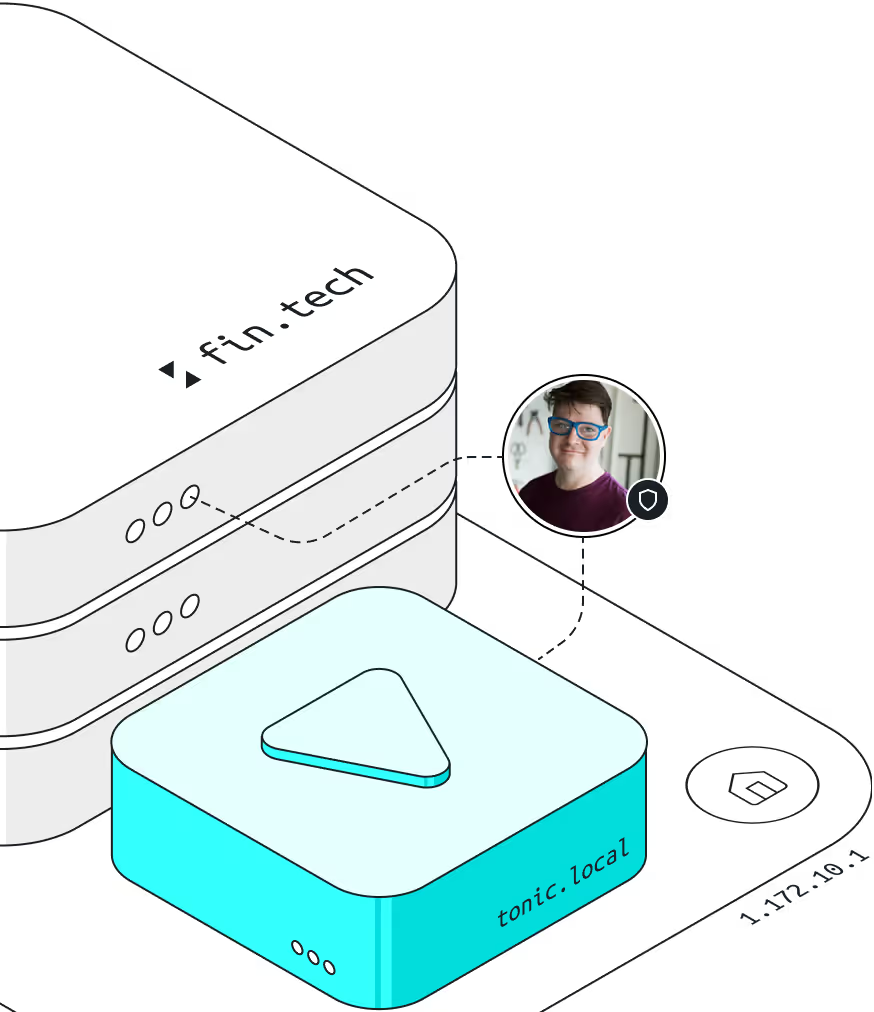
Agentic synthetic data generation, from schema to simulation
Tonic generates the data you need when production data is unavailable, insufficient, or off-limits. You describe it, agents plan and build it, and every key resolves.
Where generation starts
Synthetic data generation begins either from nothing or from something you already have. Describe what you need from scratch, hand Tonic a running database to work from, or combine both approaches inside a single project.
How the agents work together
Two agents divide the labor. The Data Agent interprets your request and writes the code that produces records; the Validation Agent checks the result and sends work back when it doesn't hold. One conversation drives both.
What keeps records consistent
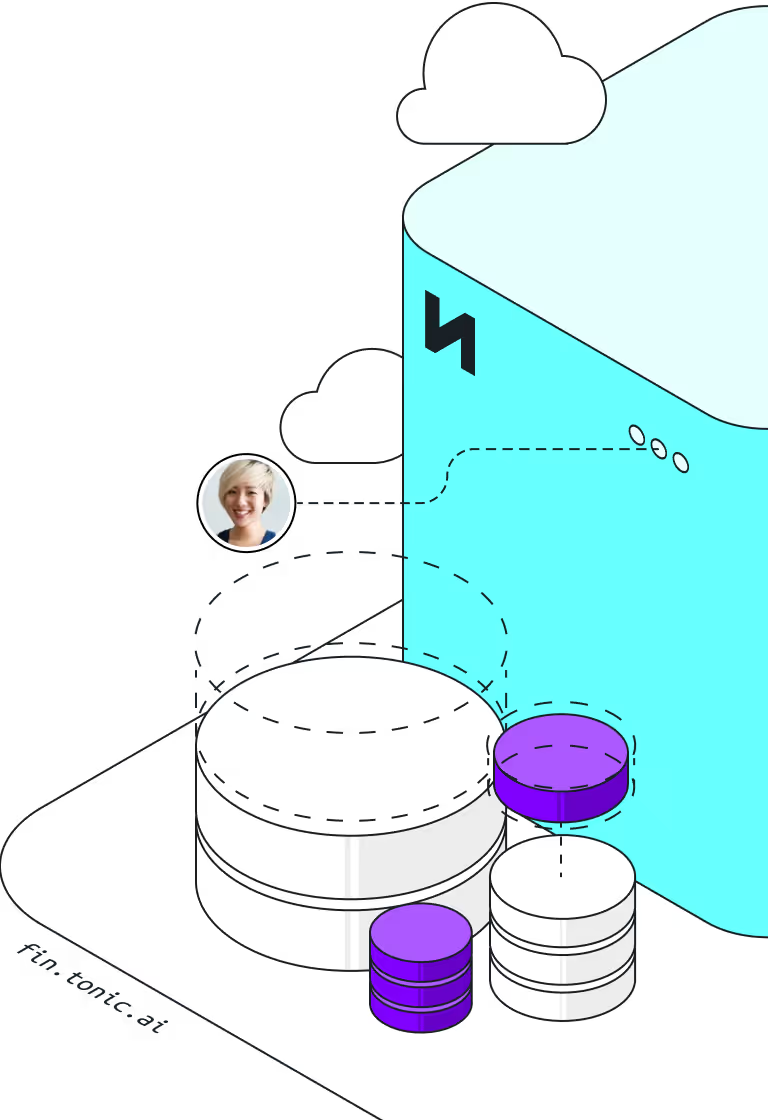
Generated records respect the keys and constraints around them, so referential integrity holds across tables, files, and services in the same project. Environments behave like production without containing a single production record.
What powers agentic synthetic data generation
Generation plans for complex schemas
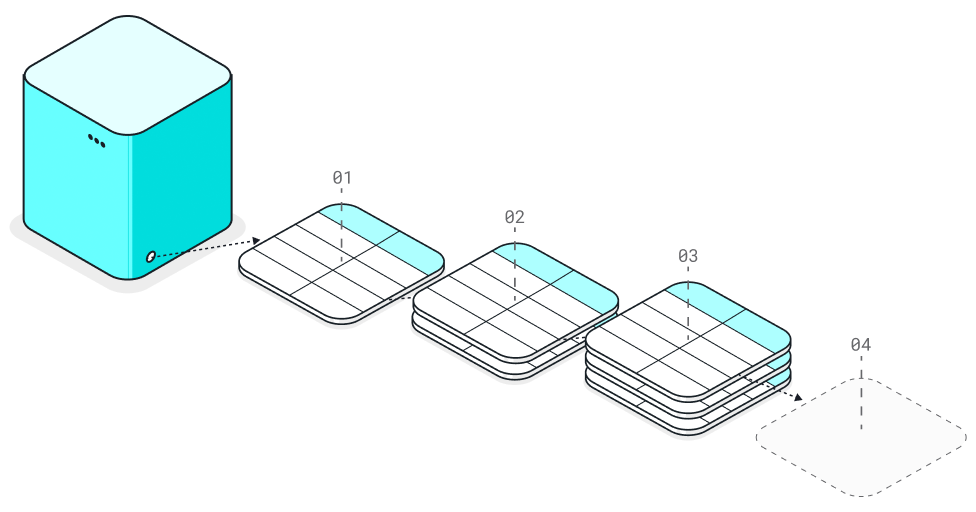
Schemas with dozens of interdependent tables rarely generate well in a single pass. Tonic Fabricate breaks the schema into a generation order you can correct before any records exist. You see the approach before you spend time on output.
Built-in data validation
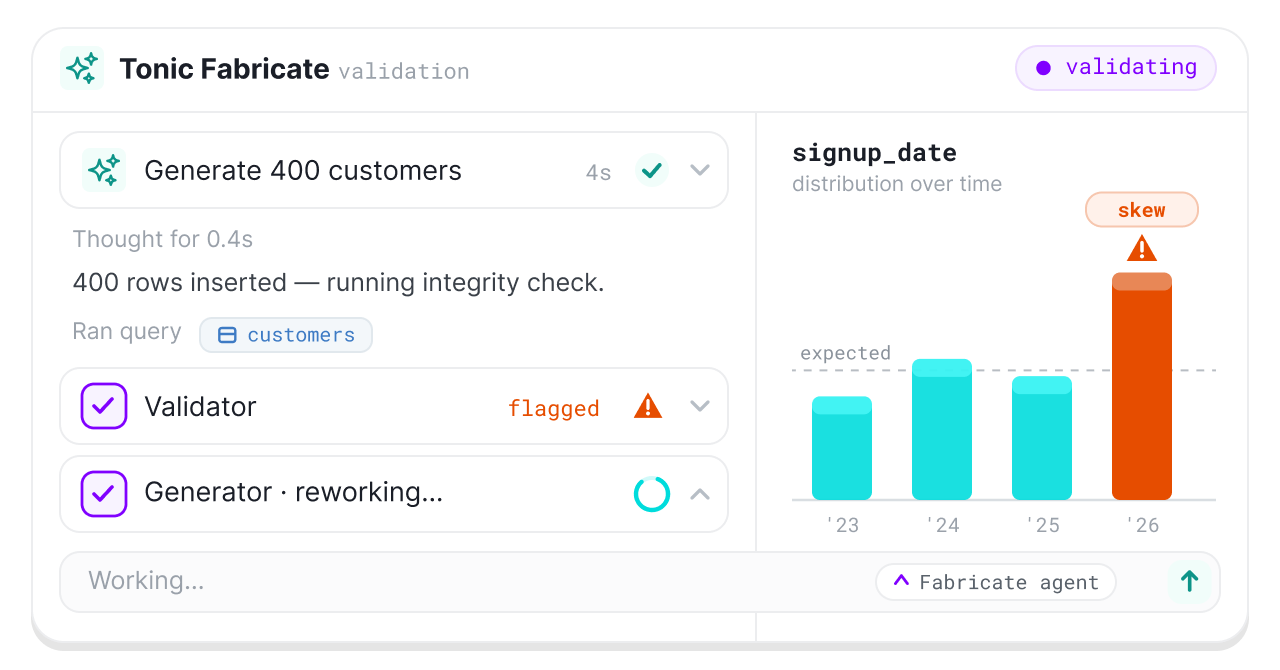
Generated data fails in ways a spot check won't catch — a distribution that skews, a relationship that survives ten rows and breaks at ten thousand. Turn validation on and a second agent audits the full output, sending records back for rework until the data holds.
Modeled on your existing database
Prose can't convey that 3% of accounts are delinquent or that order volume triples in December. Connect Tonic to the source and it takes those characteristics from the database itself. What comes out is new records shaped like your production data, not copies of its rows.
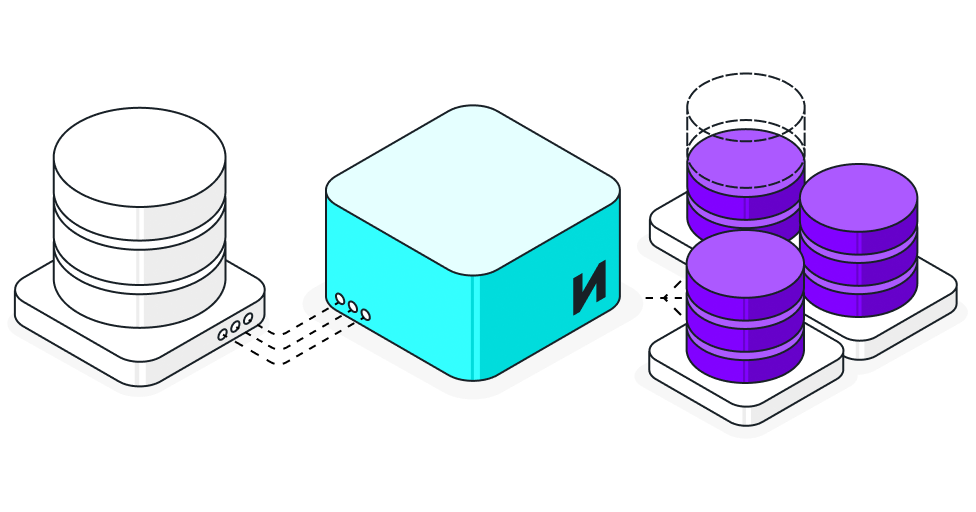
Mock APIs backed by the same records
A populated database is only half of what a client needs — the code calling it expects HTTP, not SQL. Point Tonic at an API spec and the generated records become reachable over endpoints that behave like the real service, before the real service exists.
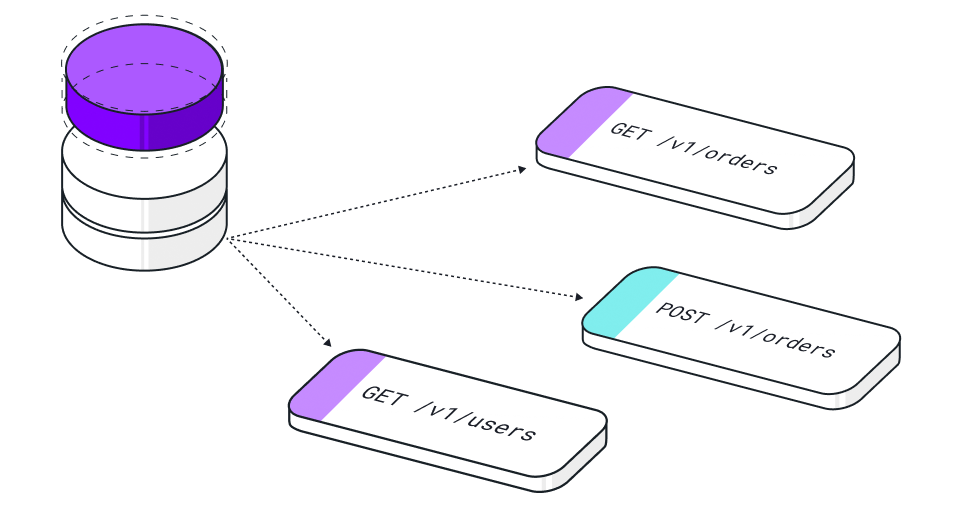
Generation inside your editor
The need for a fixture usually arrives mid-task, while you're writing the code that consumes it. The Tonic Fabricate MCP server puts generation in reach of Claude, Cursor, and VS Code, so the alternative to a real dataset stops being a hardcoded array you meant to replace.
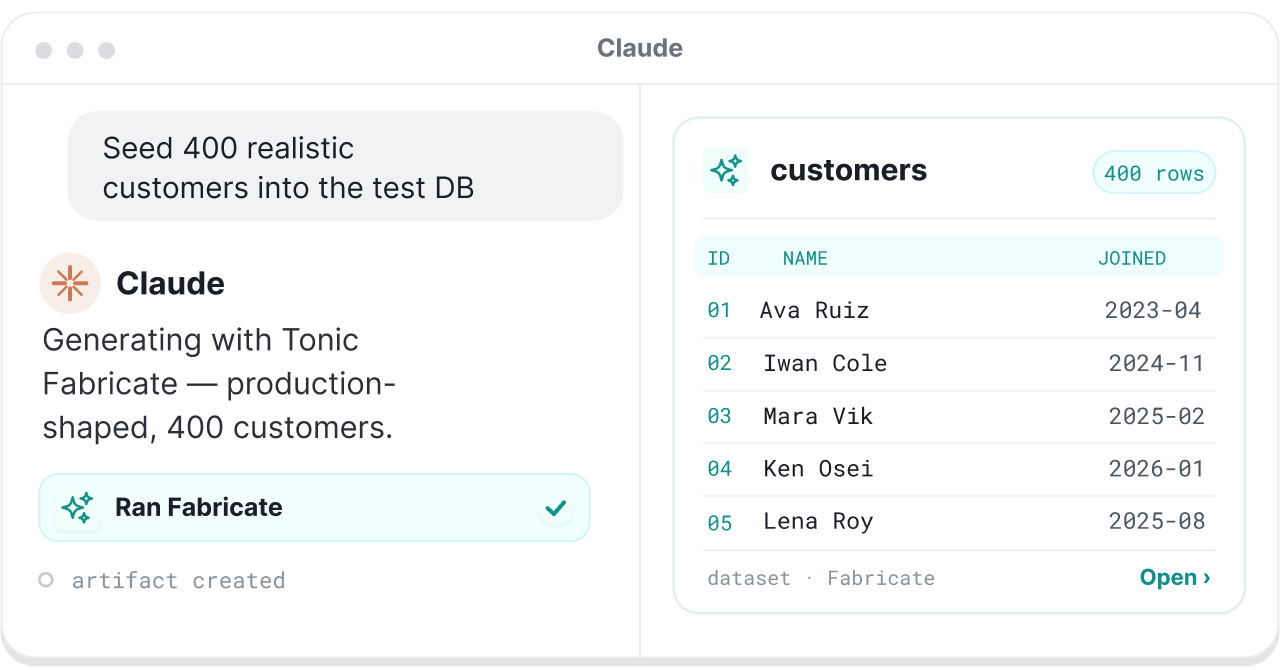
In a Tonic.ai benchmark, an open-source model fine-tuned only on Tonic-generated synthetic email data improved on the real-world Enron benchmark from 80.5% to 86%, outperforming o3 and gpt-4.1-mini without ever training on a real email.
Where a smaller database changes the work
Testing and QA environments
Shared test environments collide, and hand-maintained fixtures drift from the schema they were written against. Generate a full environment per branch instead, with the foreign keys and volumes your integration tests assume. One team's test run stops corrupting another's.
Parallel app development
Front-end and service teams block on each other when the data model exists but the data doesn't. Generate the tables and a matching mock API on day one, and both sides build against the same contract before either is finished. Neither team waits on the other.
Model training datasets
Training runs need volume, coverage of the cases that matter, and labels you can trust. Generating the corpus means you control the distribution and know the ground truth, rather than annotating whatever real data you were able to collect. Coverage becomes a design choice.
Agent evals and RL environments
An agent eval needs a world, not a table: people, messages, calendars, and tickets that all refer to the same underlying facts. Generate a company's activity across a timeline, then build graded tasks on the structured layer underneath it.
How agentic synthetic data generation works
Create a project
A project holds every database, file, and mock API you generate, so related sources stay together.
Add sources or describe the data
Connect to a live database, upload a schema, or describe what you need from scratch, including volumes and the edge cases that matter.
Review the generation plan
Large schemas get a proposed sequence first: which groups generate in what order. Iterate on the plan before any records are written.
Generate, validate, and deliver
The agents produce and check the records, then automated workflows push the result to your pipeline or a mock API.
Data synthesis questions
Synthetic data generation in Tonic runs through a conversation. You describe the data you need; an agent works out a generation order, writes the code, and produces the records. A second agent validates that output against your request. You review the sequence before anything runs, and refine results by asking for changes.
That depends on how the data was generated. Tonic tracks keys and constraints across every database and file in a project, so foreign keys resolve and shared identifiers match. A customer generated in one table has orders that point back to it correctly. Tonic Fabricate holds that consistency across databases, files, and mock APIs together.
Yes. Generating from scratch in Tonic needs only a description or a schema — no connection to a production system, and no real records in the pipeline. Teams that can't move production data out of its environment still get a full dataset for testing and QA.
A rule-based generator produces exactly what you script: you define each field, each relationship, and each distribution, then maintain all of it. Agentic generation moves that work to the agent, which infers structure, proposes an approach, and checks its own output. Control versus effort is the main axis on which synthetic data tools differ.
It depends on the task, and it's testable. In a Tonic.ai benchmark, a model fine-tuned only on Tonic-generated email data outperformed o3 on real email tasks it had never seen. Generated data also gives you known ground truth. Coverage matters more than volume for AI training data.