De-identify company data for AI
Wherever a company's history is stored, from email and chat to tickets, documents, and databases, Tonic de-identifies it at corpus scale and keeps the relationships intact, maintaining its value for licensing and training.

.svg)





What sellers, buyers, and AI teams are doing with de-identified company data
Sell it, buy it, or train on it yourself: the blocking step doesn't change. Tonic finds what's sensitive, replaces it consistently across every source, and documents the result.
License data your company already holds
License the operational history you already own. De-identify the full corpus, keep the relationships a buyer is paying for, and give legal the methodology record they need to approve the release. Tonic does all three.
Clean acquired corpora before they land
Clear corpora as fast as you can source them. Run every acquisition through one pipeline instead of staffing up per deal, or put Tonic at the source so sensitive data never reaches your environments at all. Cost per dataset falls as volume rises.
License the data a company leaves behind
Turn a wind-down workspace into a licensable asset. De-identify chat, email, drives, and tickets in one pass, and ship the evidence trail procurement will ask for before it asks. Tonic clears the whole footprint, every system and every file type.
Build RL environments on real operational data
Build environments on how work actually happens. Feed in real workspace traces and get one consistent synthetic identity per person, holding across every thread and every system. Tonic keeps multi-turn behavior coherent, so the agent learns something true.
Why teams choose Tonic.ai for company data de-identification

AI signal that survives de-identification
Keep the referential integrity a model actually learns from. Replace every name, email, and ID with a synthetic value that holds its references across the whole corpus and every system, so the person who opened a ticket is still the person who closed it.

Accuracy you can verify yourself
Run your own pipeline against ours. PrivacyBench is Tonic.ai's open benchmark for de-identifying workplace data, with datasets and scoring code both public. It grades detection and replacement together, so a pipeline that blanks everything can't win.

Documentation your buyer's legal team will accept
Hand legal something concrete. Every engagement ships a record of what was detected, what was replaced, and how the result was measured, plus an optional third-party statistician's attestation on residual re-identification risk.


Tonic's models exceed frontier model performance at a fraction of the cost
On PrivacyBench, an open benchmark measuring de-identification of enterprise data, Tonic scores 92.0% on the combined detection-and-replacement metric, 4.3 points ahead of Opus at over 60% lower cost.
PrivacyBench grades both halves of the job across synthetic email and Slack datasets: the sensitive values a pipeline finds, and the synthetic values it puts back. The datasets and the scoring code are public.
From raw company data to a corpus you can train on
Same five steps, two ways to run them
Delivered
Hand us the corpus. Tonic engineers scope it, de-identify it, and return it with the documentation behind it, plus reps, warranties, and third-party attestation scoped to your deal.
Deployed
Run it yourself, self-hosted or in Tonic Cloud, when identifiable data can't leave your environment or you expect to do this more than once.
Scope the data
Inventory every source, format, and volume, from PDFs and scanned images to DOCX, spreadsheets, and database tables, then size the work against what actually carries sensitive data.
Map identities across sources
Link each person's full name, nicknames, work and personal email, handles, and user IDs into one entity before anything is replaced.
Detect, de-identify, synthesize
Replace each sensitive value with a realistic synthetic equivalent of the same type and format, and reuse that replacement everywhere the entity appears, so semantic context and AI training signal survive.
Measure the result
Score detection and synthesis accuracy against the corpus, and review the output before anything ships.
Deliver with documentation
Ship the cleared corpus with the record behind it, ready for training or for a buyer's review.
Built for email, chat, documents, and any proprietary data source in a company workspace
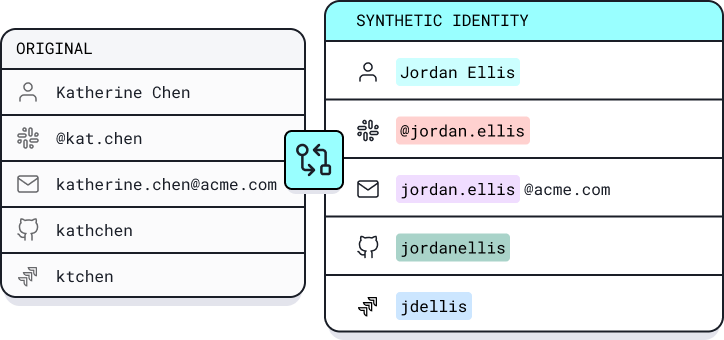
One synthetic identity everywhere the person appears
One person is a full name in email, a nickname in chat, a user ID in a ticket, and a row in your CRM. Tonic Textual resolves all four to one entity and assigns a single synthetic identity, sharing that entity map with Tonic Structural so joins across sources still resolve.
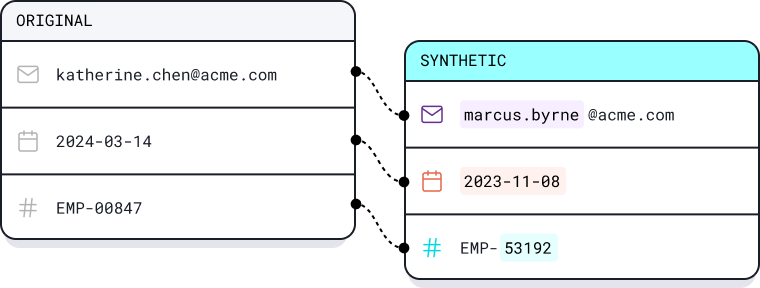
Synthetic replacements that keep their shape
A replaced email address is still a valid email address. A replaced date is still a plausible date, and a replaced ID keeps its format. Downstream parsers and tokenizers see normal text rather than gaps.
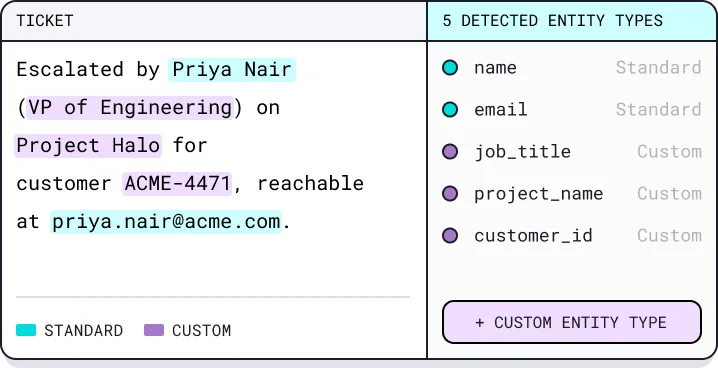
Custom entities you define
Add the entities that matter in your data. Job titles, internal project names, customer identifiers, anything your team flags as sensitive gets detected and replaced alongside the standard set.
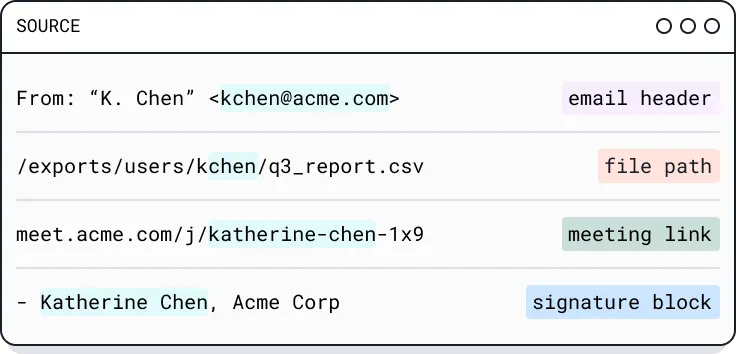
Detection tuned for where identity hides
Surface identities buried in usernames, meeting links, file paths, signature blocks, and email headers, where off-the-shelf models never look. Detection is trained on the formats real workspace systems emit.
Make your data safe for AI
Tell us what sources you have and we will scope it, delivered by us or deployed in your environment.
Common questions
Email, chat, documents and drives, wikis, ticketing systems, code repositories, CRM exports, and billing systems, or any proprietary company data in your possession, plus the databases underneath them. Coverage grows as we see new formats. Ask during scoping about anything not listed.
Either. Tonic’s privacy platform can be deployed in your own environment, or run in our cloud, and your team runs the data de-identification pipeline. Or we run the engagement and hand back the cleared corpus. Same underlying engine.
It depends on the data, the jurisdiction, and who receives it. Under the CJEU's 2025 ruling in EDPS v SRB, the same dataset can be personal data for you and anonymous for your buyer, and the EDPB's draft anonymisation guidelines turn on whether the transformation's effectiveness can be documented. That's why the record matters as much as the transformation. Your counsel decides. We give them something concrete to decide on.
Documentation of methodology and measured results comes with every engagement. Representations and warranties are scoped per engagement, and we work with attestation partners where a formal opinion such as expert determination is required. Teams working to a named regulatory standard usually pair this with compliance work.
Redaction removes the identifier and the relationship at once. Blank every name and a model can no longer tell that the person who opened a ticket is the one who closed it. De-identification for training has to replace identities consistently rather than delete them, which is exactly what PrivacyBench grades.
Frontier models find sensitive spans well and replace them inconsistently. In our benchmark testing one leading model replaced every identifier in a document set and turned a single person into three. Consistency across documents is the harder problem, and it's what our detection benchmarks measure.
Zero data retention governs inference, not training. Values in a training corpus shape the weights through every later fine-tune, and there is no reliable way to remove one example afterward. Research has documented models reproducing training sequences verbatim.
An assessment evaluates re-identification risk and produces an opinion. Tonic does the transformation: finding sensitive values inside unstructured text and replacing them consistently at scale. Many engagements need both, which is why we work alongside attestation partners.