3 principles for preserving training value when anonymizing company data
Three principles that keep anonymized company data useful for training: precise detection, coherent and consistent synthesis, and files that keep their original structure.


Preserving training value when you anonymize company data comes down to three principles: detection that finds every reference to a person or organization wherever it lives, from message bodies to file names and JSON exports; synthesis that resolves every mention to the identity it belongs to and replaces each identity coherently across the corpus; and output files that keep the structure and appearance of the originals. Together, they remove sensitive information while keeping the relationships and properties that make the data useful for training.
Real company data records how professionals actually do their work, in a level of detail AI labs have rarely had access to. Take a hypothetical eight-year workspace export from a warehouse equipment manufacturer. One account executive, Katherine Liu, appears in it tens of thousands of times: in HR records, Slack threads, CRM notes, and the contracts she signed with her largest customer, Halvorsen Freight. Around her sit the engineers' AutoCAD files, a supervisor's quarterly planning docs, screenshots shared in Slack, and years of Jira tickets. That context is critical for building reinforcement learning (RL) environments and post-training LLMs, and it's full of real people and organizations that can't reach a lab until they're de-identified. De-identifying a dataset like this has to remove every piece of sensitive information while keeping the relationships and properties in the data intact.
Company data anonymization: clear the privacy bar, then optimize for utility
In data anonymization for AI training, privacy is the bar every corpus has to clear, and utility is what the work optimizes for above it. Neither is optional. Katherine and Halvorsen Freight have to disappear from the data, and the corpus still has to show how she managed that account for eight years. Achieving both at once is what makes de-identification a complex challenge, and each principle outlined below serves both goals.
| Principle | Objective | What goes wrong without it |
|---|---|---|
| 1. Comprehensive, precise detection | Find every reference to a person or organization, in every form and place it appears | Missed entities leak real people and companies. Ordinary words mistaken for names get replaced, distorting the text. |
| 2. Coherent, consistent synthesis | Replace each identity realistically and consistently | Inconsistent replacements break the links between mentions, so the graph of who works with whom, and on which accounts, falls apart. |
| 3. Structure and format preservation | Deliver files that work and look like the originals | Files that break structure or format no longer parse, render, or read like real documents. |

1. Comprehensive, precise detection
Detection has to find every reference to a person or organization in the corpus. That starts with personal information like names, email addresses, and employee numbers, and extends to the organizations in the data: customers, vendors, partners, and the products and brands that would identify them. Nothing in the corpus labels any of it. In Katherine's export, identity hides in three ways:
- Where it sits. Names live in signature blocks, URLs, attachments, letterheads, email domains, screenshots, scanned images, the title block of an AutoCAD drawing, and file names like
Halvorsen_MSA_2021.pdf, not only in message bodies. - How it's written. Katherine is Katherine Liu in HR records, Kate in Slack, kliu in usernames, and K. Liu on CC lines. Her customer is Halvorsen Freight in contracts, Halvorsen in chat, HF in the CRM, and halvorsenfreight.com in email headers. Each source encodes identity its own way, so the difficulty compounds with every source you add.
- What identifies without naming. Employee numbers and account numbers, like the HF-20417 on every Halvorsen invoice, point at one person or company directly. A job title, project name, or office location can single someone out in combination, and a logo, brand colors, or typeface on a sales deck can identify Halvorsen without its name ever appearing. And because a company's people and customers are a finite, often public group, detection has to hold up against someone who checks the data against a team page or a customer list.
The data's intended use can also widen what counts as sensitive. Some datasets need confidential business details removed along with personal information, while an RL environment that simulates Katherine's sales team may need realistic deal structures left in place.
Detection can fail in two directions. Missing an entity leaks a real person or company into the corpus. Flagging too much is subtler. If someone at the company is named Mark, a detector that matches on names alone will flag "mark the invoice as paid" and replace the verb. Getting the entity type wrong causes its own damage. Halvorsen's storage vendor, John Small's Storage, has to be caught whole, as an organization. Tag "John Small" as a person and leave "Storage" behind, and you get a synthetic name stapled to a fragment of the real business.
Accurate detection requires named entity recognition that reads the context around a word, not just its shape. No model catches everything across years of email and chat, which is why human-in-the-loop QA matters as much as the models do. A reviewer who checks samples of the output against the source brings judgment that complements the models: confirming the rare ambiguous case, and tuning detection to the habits of a particular dataset, like an internal shorthand or a naming convention unique to one company. Strong models paired with expert review are what let a corpus clear the privacy bar with confidence.
2. Coherent, consistent synthesis
Once detection finds a sensitive value, it needs a replacement. Redaction removes the value altogether or swaps in a placeholder like [NAME]. Synthesis replaces it with a realistic value of the same type. The difference is evident in a single line:
For training data, redaction alone typically doesn't hold up. It was built for documents people read, not data models learn from. The redacted line tells a model almost nothing: two people collapse into the same placeholder, the customer disappears, and across a full corpus the model is left with text full of holes and no way to follow who said what to whom. The synthesized line keeps all of that. It has two distinct people, a customer that reads like a real company, and a thread a model can follow. Choosing synthesis doesn't weaken privacy; anonymization is defined by the outcome, not the method. Data counts as anonymized when no one in it can be identified, regardless of the approach you took. Synthesis also makes detection's rare misses harder to spot. A real name left in redacted text is the only name in a sea of placeholders, while among realistic replacements it no longer stands out at a glance.
Realistic replacements also have to be consistent. Katherine has to become Elena Brooks in every one of her mentions, and Halvorsen Freight has to become Brightwater Logistics in every contract, chat, and invoice. That consistency is known as referential integrity. In structured data, it means a record pointing to a customer ID still points to the right customer, and keys between tables enforce it. Company data has no keys to lean on, so referential integrity depends on entity resolution instead: linking every mention, in every form, back to the person or organization it refers to. With that mapping in place, consistency has to then hold in several ways at once:
- Across messages: every mention of a person or company resolves to the same synthetic identity, in every thread.
- Across files: that identity holds in PDFs, documents, spreadsheets, and CSVs, as well as in email and chat.
- Within an identity: when Katherine Liu becomes Elena Brooks, Kate becomes Ellie, kliu becomes ebrooks, and the email address, handle, phone number, and ID all realistically belong to Elena Brooks.
- Across an organization: every form of Halvorsen's name, along with its domain, addresses, account numbers, and brand details like product names, maps to one synthetic organization.
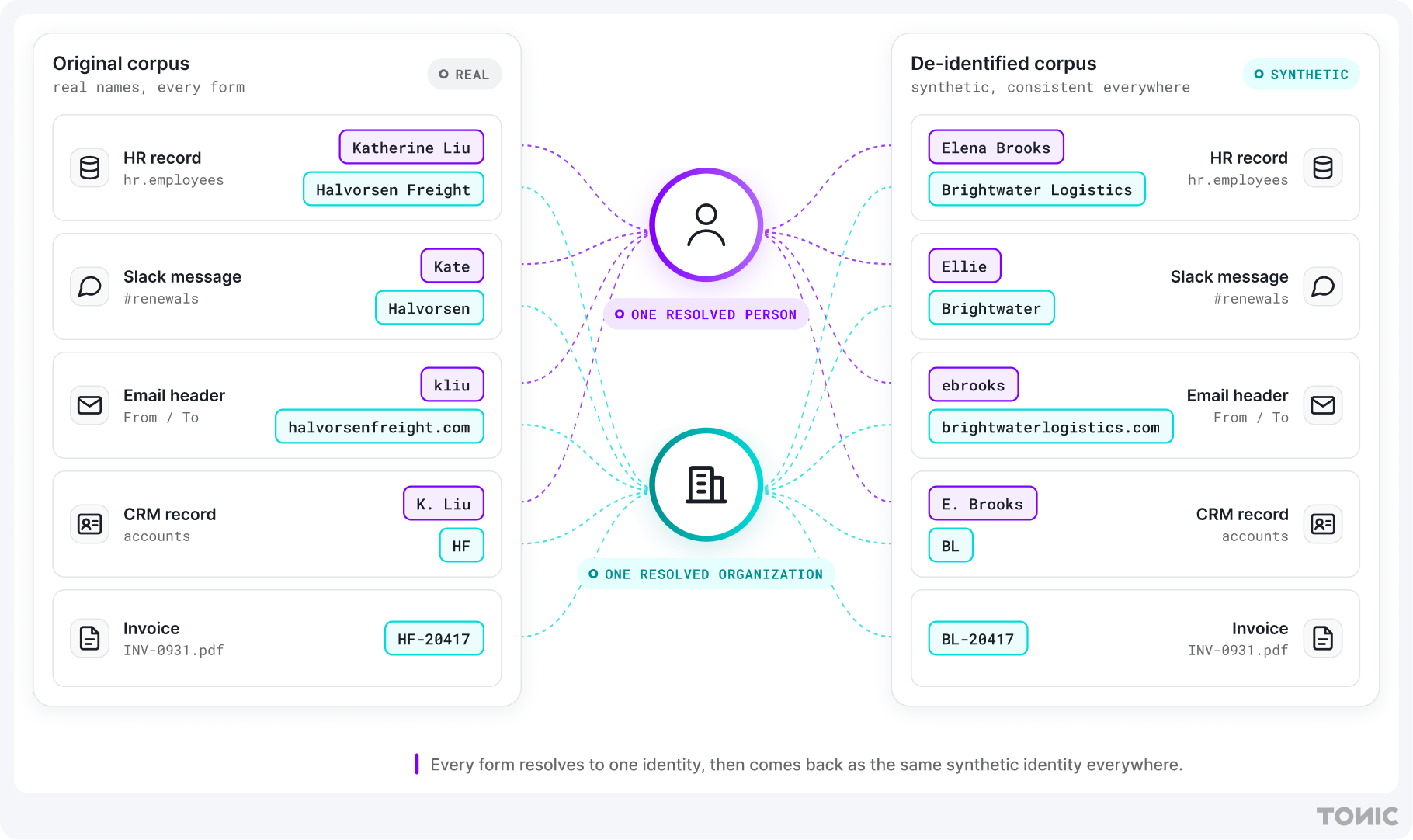
Tonic achieves this by way of Identity Synthesis, our proprietary approach to entity resolution and coherent synthesis. We resolve every mention into a graph of who is who across the corpus, then generate consistent replacements based on that graph rather than file by file. Identity Synthesis can also keep the gender and cultural context of each original name, so a multinational workforce doesn't flatten into generic names, and pronouns still match the people they describe.
Without that consistency, the graph of relationships in the data falls apart, even when every file looks clean on its own. If Katherine becomes Elena in Slack and Grace in her HR record, the links between her messages, her accounts, and her colleagues break, and a model sees two people who never interact. The reinforcement learning environments built on that corpus then ask an agent to reason about relationships that no longer exist. Replacements that ignore context break the data in a different way, teaching patterns no real company has, like an employee whose email address belongs to someone else.
3. Structure and format preservation
De-identified files have to work and look like the files they came from. Company data isn't only text. It's JSON exports, PDFs, slide decks, spreadsheets, screenshots, and CAD drawings, and the RL environments and agents built on it work with those files directly. A corpus that reads well as extracted text but no longer opens, parses, or renders like the original has lost much of its value.
- Structured files still work. A de-identified Jira export has to keep the schema, keys, and field types of its semi-structured data, so the JSON loads into the system it came from the same way the original did.
- Documents keep their layout. In a PDF, a synthetic name has to take up the same space as the original, so Halvorsen's signed contract doesn't turn into misaligned text and stray whitespace.
- Images keep their look. When Katherine's name appears in a Slack screenshot or a scanned invoice, the replacement has to match the original font and background color, or the edit shows at a glance.
Why effective de-identification depends on all three principles
Each principle depends on the one before it. Detection gives synthesis everything it needs to replace. Synthesis gives every person and organization one consistent identity the corpus can hold onto. Structure and format preservation delivers that corpus in files that work the way the originals did. Skip any one, and the other two can't make up for it.
This is also why a pipeline should be judged on what it delivers, not one stage at a time. We built PrivacyBench, Tonic.ai's open benchmark for de-identifying workplace data, to measure the whole job. Each pipeline receives raw email, Slack, and document exports, and has to extract the text, detect the personal information, replace it coherently, and write the files back out in their original formats. The benchmark scores detection recall (the share of real PII found, checked against human-annotated data) and synthesis accuracy (how coherently the pipeline replaced what it found), and combines them into one end-to-end score. Tonic's Identity Synthesis pipeline led the seven pipelines tested at 95.3% end to end, and replaced what it detected coherently 94.3% of the time, against 87.5% for the next-best pipeline. The datasets are on Hugging Face and the scoring code is on GitHub, so you can score your own pipeline against the same exports.
We've spent years on this problem. Tonic.ai started with structured data, de-identifying production databases with Tonic Structural, then extended that work to unstructured text with Tonic Textual. Today, Tonic.ai provides company data de-identification as an independent third party. We anonymize full company corpora, from email, chat exports, and tickets to PDFs, slide decks, spreadsheets, scanned images, AutoCAD files, and CRM and HR records, detecting and replacing names, logos, IDs, and other sensitive data along the way. We write each file back out in its original format, with layouts, fonts, and background colors preserved.
The technical and legal sides of de-identification depend on each other. A legal standard is only as strong as the technical work that carries it out, and that work only holds up if it's built to meet what de-identified actually means under the laws that apply. Our tenets for de-identification in AI data licensing propose an industry standard for de-identifying company data before it's licensed, from who should de-identify company data to how the work should be governed. Taken together, the three principles outlined in this article are the technical side of that standard: what de-identification has to deliver before company data is both safe to license and useful for training.
If you're preparing company data for RL environments or post-training, whether it comes from familiar sources or a niche ticketing tool, a homegrown CRM, or a source nobody has handled before, speak with a privacy expert on our team about your de-identification needs.
Frequently asked questions
Redacting is a technique: it removes a sensitive value or hides it behind a placeholder. Anonymizing is a result: no one in the data can be identified. Redaction is one way to get there, but it typically removes the detail a model learns from. Realistic synthetic replacements, meanwhile, anonymize the data and keep it reading like the original. Data redaction suits text that only needs to be read, not learned from.
It means every reference to a person or organization still points to the same synthetic identity after de-identification. In a database, keys between tables make that simple to enforce. Company data has no keys, so consistency has to be rebuilt by recognizing that Kate, kliu, and K. Liu are one person. Without referential integrity, one person splits into several and the corpus stops describing how people worked together.
For training data, yes. RL environments and agents work with real files, so a de-identified JSON export has to load into the system it came from, and a PDF or screenshot has to look like the original. A corpus that only survives as extracted text loses much of what makes reinforcement learning environments realistic.
Often, but not always. Personal information always comes out. Business information like customer accounts, pricing, and contract terms depends on what the data is for. An RL environment that simulates a sales team may need realistic deal structures left in place, while a corpus licensed for broad post-training may need them removed. Quality company data de-identification tunes detection to the dataset's end use.
Check the finished files, not each step on its own. A detector can find nearly everything and still hand off to a replacement step that splits people into several identities, and that only shows up in the output. A useful evaluation looks at both how much sensitive data was found and how coherently it was replaced. PrivacyBench scores pipelines this way on raw workplace exports, with public datasets and scoring code.
Adam Kamor, Co-founder and Head of Engineering at Tonic.ai, leads the development of synthetic data solutions that enable AI and development teams to unlock data safely, efficiently, and at scale. With a Ph.D. in Physics from Georgia Tech, Adam has dedicated his career to the intersection of data privacy, AI, and software engineering, having built developer tools, analytics platforms, and AI validation frameworks at companies such as Microsoft, Kabbage, and Tableau. He thrives on solving complex data challenges, transforming raw, unstructured enterprise data into high-quality fuel for AI & ML model training, to ultimately make life easier for developers, analysts, and AI teams.