Tonic Fabricate is a purpose-built synthetic data platform that generates and operationalizes referentially intact data across your entire data ecosystem, compared to Claude, which is a general-purpose LLM that can generate text-based data output but lacks the infrastructure to manage schemas, enforce data integrity, or push data into pipelines. If you're evaluating Tonic Fabricate vs. Claude for synthetic data generation, that architectural difference shapes everything downstream.
A growing number of engineering teams are turning to Claude and other LLMs as ad hoc synthetic data generators. The appeal is obvious: you already have access, the interface is flexible, and for a quick mockup it gets the job done. Gartner predicts that 75% of businesses will use generative AI to create synthetic data by 2026, and much of that early experimentation starts with a general-purpose LLM.
But synthetic data generation with LLMs is a different problem than text generation. Real-world software doesn't run on a single table — it runs on interconnected databases with shared keys, business logic constraints, and format-specific validation rules that a language model was never designed to enforce. For anything beyond a one-off JSON blob, you need more than a brain. You need infrastructure.
We ran a head-to-head comparison between Fabricate and Claude Code, and the results were clear: Fabricate was 2x faster, 2.5x cheaper, and produced significantly higher-quality data with less effort. While this article focuses on Claude, the LLM most frequently mentioned in these conversations, the same limitations apply to using ChatGPT, open-source models, or any general-purpose LLM for data generation.
Here's how the two approaches compare across the criteria that matter most.
What is Tonic Fabricate?
Tonic Fabricate is an AI-powered synthetic data platform purpose-built for generating and operationalizing realistic data at scale. Fabricate treats synthetic data as a data engineering problem, not a text generation problem, and that distinction shapes every layer of the product.
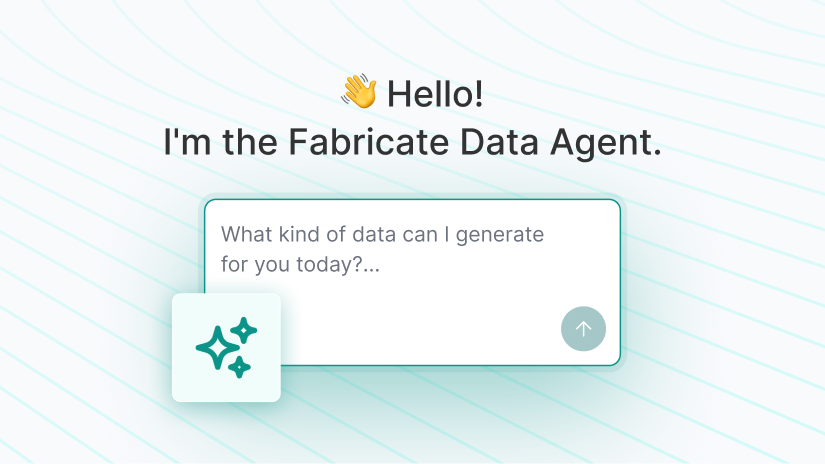
Its agentic approach means you can describe the data you need in natural language, connect to live databases to model from existing schemas and distributions, or combine both approaches. Fabricate handles the rest. Within a single conversation, Fabricate generates referentially intact data across multiple databases and file formats.
For complex schemas, it drafts a strategic generation plan before creating a single record, giving you visibility into the approach and control over every step. When you want an added layer of quality assurance, the Validation Agent reviews what the Data Agent generates and prompts refinements automatically, looping until the data matches your request.
Once your data is ready, Fabricate can create automated workflows for putting the data to use and mock APIs that slot directly into your development, testing, and training pipelines. Fabricate supports structured and unstructured output — relational databases, JSON, PDFs, docx files, and more — all logically consistent within a single generation run.
What is Claude?
Claude is a general-purpose large language model built by Anthropic. It's one of the strongest LLMs available — flexible, capable, and genuinely useful across a wide range of tasks. Its natural language interface makes it easy to prompt for domain-specific content on demand, the barrier to entry is low, and its NLP capabilities are strong. Through Claude Code, developers can use it to write and execute scripts in a sandboxed environment, which extends its utility from pure text generation into code-driven workflows.
For synthetic data, Claude's appeal is straightforward: you describe what you need, and it generates it. For a quick prototype — a flat JSON file of fake users, a handful of sample records for a frontend mockup — that works well. A growing number of developers are using Claude and similar LLMs as synthetic data generation tools for exactly these lightweight use cases, and the results can be genuinely useful for early-stage development work.
The question is what happens when your needs outgrow a single prompt.
Fabricate vs. Claude: Speed and cost of synthetic data generation
In head-to-head testing, Tonic Fabricate was 2x faster end to end and 2.5x cheaper in token spend than Claude Code for synthetic data generation.
The speed gap comes down to architecture. Fabricate is tuned for data generation: it reaches useful output quickly because the platform handles schema inspection, constraint validation, and data insertion natively. There's no scaffolding to build before you get results. You describe what you need, and the platform produces structurally valid data in a single pass.
With Claude, the path from prompt to usable dataset is longer. You spend significant time and tokens on prompt engineering, debugging malformed output, and iterating through corrections before arriving at data that's structurally valid. Each iteration consumes additional tokens, and for complex schemas, the context window becomes a constraint that forces you to split the work across multiple sessions, introducing opportunities for inconsistency.
The cost difference reflects this compounding overhead. In both time and token spend, you’re paying for the gap between what a general-purpose model can infer and what data generation actually requires. That gap is small for a single flat table, but it widens quickly once you add referential constraints, format validation, and multi-system generation.
For teams generating data regularly rather than as a one-off exercise, that overhead compounds with every generation cycle. Fabricate's purpose-built architecture eliminates it from the start.
Usability and prompt engineering effort
Tonic Fabricate requires significantly less prompt engineering to produce a usable result. A prompt like "I want healthcare data that fits in an EMR" returns a structurally valid dataset on the first try. Fabricate's one-shot performance is strong because the platform understands data generation as a domain: it knows what schemas look like, what constraints need to hold, and what questions to ask before filling in gaps.
That last point is worth emphasizing. Fabricate uses anti-assumption logic: it queries your actual schema and asks clarifying questions before generating rather than guessing. If your database has a field it doesn't have context for, it asks you. Claude, by contrast, fills gaps with its training data. That might produce output that looks plausible but doesn't reflect your actual business logic, a subtle failure mode that's easy to miss and expensive to debug.
With Claude Code, you invest substantial time in writing detailed prompts, reviewing output, identifying structural problems, and refining. And that's the prompt engineering phase, before you start fixing the data itself. The effort required to go from "Claude generated something" to "this data is usable in my pipeline" is where the real cost lives.
Fabricate can take that review step off your plate. With the Validation Agent enabled, a second agent reviews the Data Agent's output, flags anything that doesn't match your request, and drives refinements automatically. The review loop you run by hand with Claude becomes an automated pass inside Fabricate.
For engineers whose time is better spent on core product work, that distinction matters.
Data quality and structural validity
This is the core technical argument for why Claude Code synthetic data generation falls short of a purpose-built platform, and it comes down to how the two systems approach the problem.
LLMs are probabilistic, not deterministic. Claude predicts the next plausible token. It doesn't run validation logic. Ask it for a credit card number and you might get 16 digits that fail a Luhn check. Ask it for a national ID and the format might look right but be structurally invalid. The output reads like data, but it doesn't behave like data.
Fabricate uses a hybrid engine: the LLM handles creative, domain-specific content (names, descriptions, free-text fields) while deterministic code handles mathematically rigid fields — checksums, format-validated IDs, enum constraints — in a secure sandbox. You get the realism of AI-generated content with the correctness guarantees of programmatic validation.
Baseline data quality reflects this split. Head-to-head testing showed that Fabricate produced more realistic, structurally valid records across the board. Claude Code showed obvious failure modes — contradictory events on the same day for a single persona, for example — that Fabricate avoids by design. When you're generating data for testing or model training, those inconsistencies aren't cosmetic. They propagate through your test suites and training pipelines, introducing noise that's difficult to trace back to its source.
The LLM synthetic data limitations here aren't about capability. Claude is a powerful model. But generating structurally valid, domain-correct data at scale is a different problem than generating plausible text, and a general-purpose language model isn't optimized for it.
Coherence across large and relational datasets
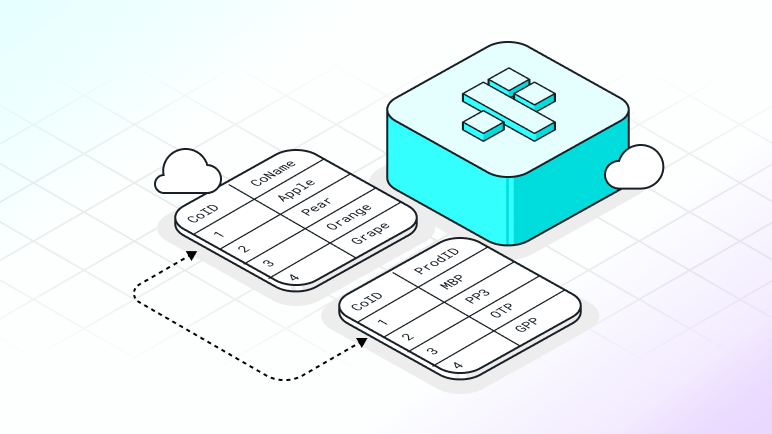
Generating one table is easy. Generating 50 tables where foreign keys align, business logic distributions hold, and cross-table dependencies are preserved is a fundamentally different problem, and it's where the general-purpose LLM approach breaks down most visibly.
LLMs operate within a finite context window. As the generation run grows, the model loses track of earlier records, relationships, and constraints. The result is data that contradicts itself: a customer record that references an order ID that doesn't exist in the orders table, or a transaction dated before the account it belongs to was created. In head-to-head testing, Fabricate maintained context and consistency across long generation runs while Claude produced records that contradicted earlier data.
Tonic Fabricate's architecture is built for this. It inspects schemas, identifies constraint violations during data insertion, and patches generation code automatically. Referential integrity isn't a best-effort outcome — it's enforced at the system level. When you generate data across multiple interconnected databases in a single Fabricate conversation, the platform tracks the relationships between them and validates as it goes.
For any dataset beyond trivial size, and especially for the interconnected, multi-system architectures that real-world software runs on, coherence at scale is not optional. It's the difference between synthetic data you can trust and synthetic data you have to manually audit.
Infrastructure and operationalization
This is what the Fabricate team calls "the body argument," and it's apt. Claude is a brain without a body. It generates text. It doesn't connect to your Oracle or Postgres database. It doesn't export to Parquet or stand up a mock API. It doesn't manage state, revert bad generations, or push data into a CI/CD pipeline.
If you build all of that yourself, you're not "just using Claude." You're building and maintaining a data platform from scratch: writing database connectors, handling token limits and context window management, building retry logic for malformed outputs, sandboxing code execution, and maintaining all of it as models change. Every hour your engineers spend on that infrastructure is an hour not spent on your core product.
Tonic Fabricate provides this operational layer out of the box. Database connectors let you push generated data directly into your target systems. Automated workflows define repeatable tasks (validation, API delivery, additional generation) as custom workflows callable via API and reusable across your pipelines. Mock API creation lets you upload an API spec and stand up a functional mock alongside the data to fuel it, unblocking frontend and backend teams in parallel.
Quality control is part of that body too. AI development accelerated once teams paired generation with automated review: one agent builds, another checks. Recreating that around Claude means orchestrating multiple agents and maintaining the hand-offs, retries, and state between them yourself. Fabricate builds the loop in, with the Validation Agent reviewing the Data Agent's output and driving refinements automatically.
Governance matters here as well. Who has access to the generation schemas? How do you audit what was generated? How do teams share and reuse datasets? Internal scripts built around Claude rarely get investment in access controls, audit trails, or team collaboration features. Fabricate provides these by default, which matters the moment your synthetic data practice moves from one engineer's side project to an organizational capability.
Comparison summary
When Claude might be enough (and when it isn't)
If you need a one-time, flat JSON blob for a frontend mockup (e.g. a handful of fake users to populate a UI prototype) a quick Claude prompt is genuinely fine. For ad hoc, single-table generation where the data doesn't need to be structurally valid or referentially intact, a general-purpose LLM is a reasonable Claude alternative for synthetic data in the narrowest sense. That said, Fabricate handles that simple case just as easily, and a free account gets you there with the option to scale when your needs do.
The fact is, most teams don't stay simple for long. The moment you need multiple related tables, valid data types, repeatable generation pipelines, or data at scale, the DIY approach starts breaking. And the gap widens quickly: connecting to real databases, maintaining referential integrity across systems, standing up mock APIs, and operationalizing generation into your CI/CD pipeline are all problems that a language model doesn't solve, no matter how good the prompt engineering is.
The inflection point is predictable. You start with a quick prompt. Then you need a second table that references the first. Then you need the data to actually pass validation. Then you need to regenerate it weekly. Then another team wants access. Each step adds complexity that a general-purpose LLM wasn't built to handle, and each step is where Fabricate's purpose-built architecture pays off.
Bottom line: Synthetic data generation is a data engineering problem
Claude is a powerful LLM. But synthetic data generation is a data engineering problem, not a text generation problem. It requires schema awareness, referential integrity enforcement, structural validation, operational infrastructure, and governance — none of which are things a language model provides on its own. When you build vs. buy synthetic data infrastructure, the question isn't whether Claude can generate data. It's whether the engineering cost of building everything around it is worth what you'd save by using a platform that already has it.
Tonic Fabricate is purpose-built for this. Head-to-head testing confirms it: faster, cheaper, higher-quality data, with the infrastructure to operationalize it. When your team stops building scaffolding and starts generating data, the bottleneck disappears, and the projects that were waiting on data move forward.
Try Fabricate for free and see the difference for yourself.

A bilingual wordsmith dedicated to the art of engineering with words, Chiara has over a decade of experience supporting corporate communications at multi-national companies. She once translated for the Pope; it has more overlap with translating for developers than you might think.