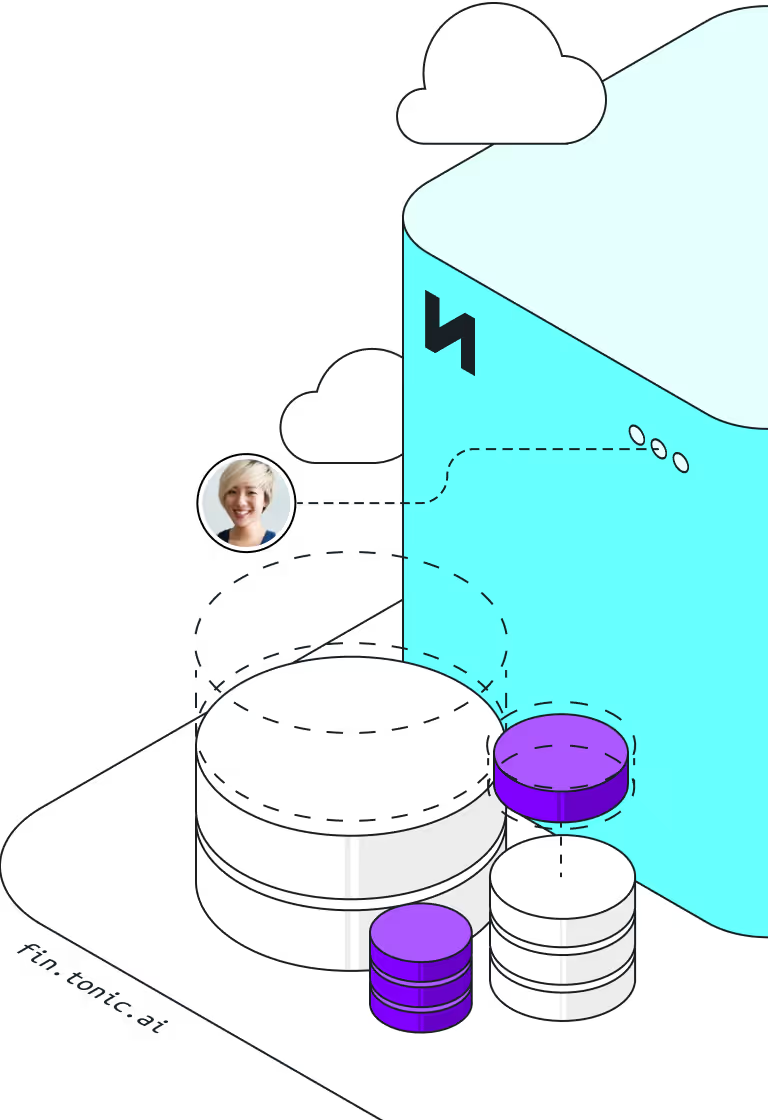
Deterministic masking is a data masking technique in which the same input value always produces the same masked output. So for instance, “Jane Smith” becomes “Laura Jones” every single time. When properly implemented, this happens across every single table, database, and environment for which consistency in data masking is required. It protects sensitive data while preserving the structure and relationships that make that data useful.
How deterministic masking works
Deterministic masking relies on a function (typically a hash, encryption algorithm, or lookup table) that maps each real value to a fixed substitute. The mapping is stable. Run the same input through the same function and you always get the same output.
When this is applied at the database level, every foreign key, join, and cross-table reference that points to a real value gets replaced with the same masked equivalent. The result is a dataset that looks and behaves like production data, with all its internal relationships intact, but with no real sensitive values exposed.
It’s like changing somebody’s name in a story, but keeping that same name consistent throughout the entire story.
Deterministic masking vs random masking
Random masking replaces sensitive values with a different random substitute on each run. This offers strong protection against re-identification, but breaks referential integrity. Deterministic masking trades a small degree of that randomness for consistency.
Relationships between records are preserved because the same value maps to the same substitute. For most software development and testing use cases, that consistency is essential.
Common use cases
Deterministic masking is warranted anywhere consistent, relational data is needed outside of production:
- Software testing and QA: Foreign keys and entity relationships work correctly across the masked dataset.
- Multi-environment development: As data flows from development to staging to QA, it must remain consistent to keep all environments in sync.
- Third-party and offshore collaboration: Data can be safely shared with vendors or external teams.
Benefits of deterministic masking
- Enhanced data security: Names, numbers, and any other sensitive information is swapped out with an output that still maintains the integrity of the original data.
- Regulatory compliance: Keep prying eyes off sensitive data. This is in compliance with GDPR, HIPAA, and CCPA.
- Simplified data sharing: Data is easier to work with when the substitute is consistent.
How deterministic masking ensures data privacy
Deterministic data plays an essential role in ensuring that sensitive data is protected. Organizations can maintain data privacy during testing, avoiding compliance issues and legality failures. Because the transformation is one-way, the original value cannot be reverse-engineered from the masked output alone. Sensitive identifiers are replaced with plausible substitutes that carry no real-world meaning.
Tonic.ai offers deterministic masking within and between both of its de-identification platforms, Tonic Structural and Tonic Textual. With Tonic.ai, organizations can optimize their data protection strategies and generate quality data to speed up developer productivity.