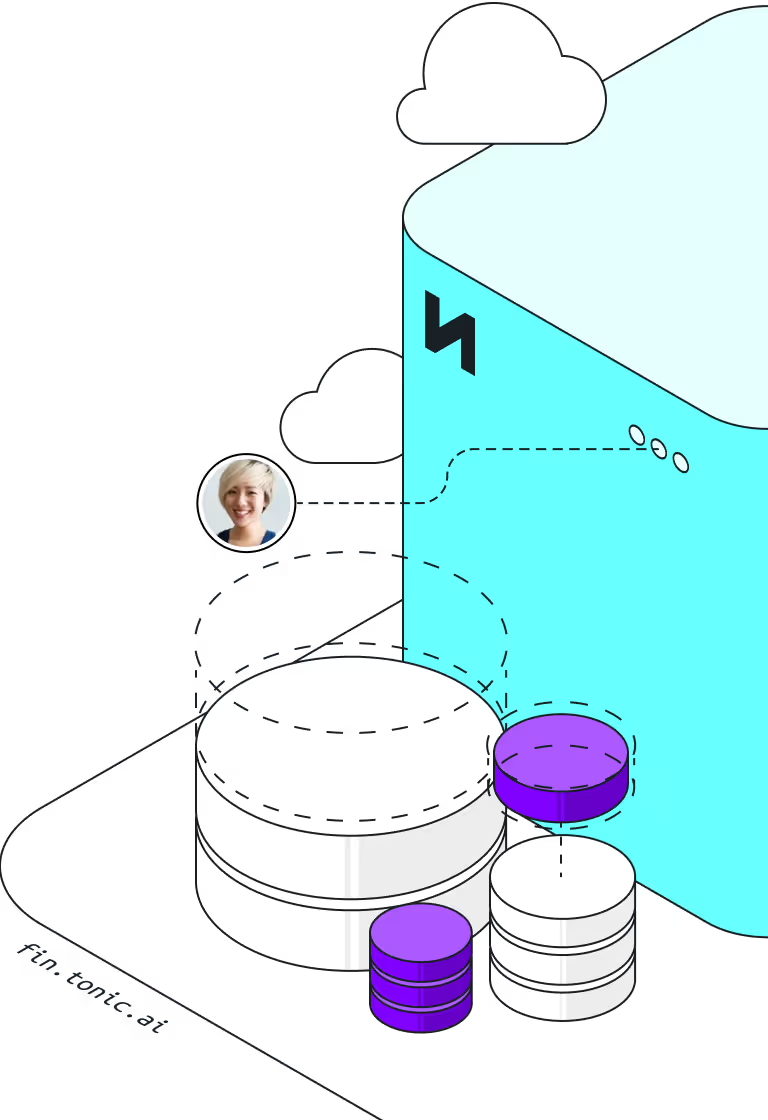
Data augmentation is the process of creating new training examples by applying transformations to existing data, expanding a dataset's size and diversity without collecting new source data. Common techniques include rotating or flipping images, paraphrasing text, adding noise to audio, and perturbing values in structured records within realistic bounds. Data augmentation helps machine learning models generalize better and reduces overfitting, especially when the original dataset is small, imbalanced, or lacks the variation a model will encounter in production.
Common data augmentation techniques
Techniques vary by data type. Image datasets are augmented through rotation, flipping, cropping, color jittering, and adding noise. Text datasets use paraphrasing, synonym replacement, back-translation, and random word insertion or deletion. Audio datasets apply pitch shifting, time stretching, and background noise injection. Structured or tabular datasets are augmented by perturbing numeric values within realistic ranges, swapping categorical fields, or oversampling underrepresented classes — a technique known as SMOTE. Layering multiple techniques on the same record (rotating and adding noise to one image, for example) multiplies the effective dataset size further, though over-augmenting can introduce artifacts that don't reflect the real-world variation a model will actually encounter.
Each technique produces a new example derived from one that already exists — augmentation transforms what's already in the dataset rather than generating entirely new records from scratch. That's the practical distinction between data augmentation and full synthetic data generation.
Why data augmentation matters
Collecting and labeling more real-world data is slow and expensive, and some gaps — rare edge cases, underrepresented classes, sensitive or hard-to-source records — can't be closed by collecting more of the same data at all. Augmentation is a low-cost way to expand a dataset's effective size and diversity, which reduces overfitting and helps a model generalize to inputs it didn't see during training. It has a ceiling, though: augmentation can only vary what already exists in the dataset, so it can't manufacture a category of data the original dataset never captured in the first place. That's the gap synthetic data generation is built to close.
How Tonic.ai addresses this
Tonic Fabricate extends data augmentation into full synthetic data generation: rather than only transforming existing records, Fabricate generates new synthetic data modeled on an existing dataset, with labels built in because Fabricate creates the data itself. This pairs naturally with Tonic Textual, which de-identifies sensitive information in an unstructured dataset first, then Fabricate uses that de-identified data as inspiration to generate additional examples, augmenting datasets that are too scarce or narrow for reliable model training. The workflow is backed by Fabricate's data synthesis capability, which can model new data on an existing dataset or generate it from scratch.