Applications rarely run on a single datastore. A typical test environment will likely pull from a legacy on-prem relational database, a cloud warehouse, a few SaaS apps, and whatever semi-structured artifacts your pipelines emit—JSON events, CSV extracts, Parquet files, log lines.
When you try to manage test data from multiple sources, the hard part isn't generating rows—it's keeping those rows consistent across systems that weren't designed to be provisioned together. If your test data doesn't line up, you get data silos: each team has a locally "working" dataset, but end-to-end flows break during late-stage QA when services finally integrate.
A unified Test Data Management (TDM) strategy gives you a single way to provision realistic, privacy-aware data while preserving schema alignment and referential integrity across your entire test ecosystem.
The challenges of managing data from multiple sources
Multi-source test environments create bottlenecks because data provisioning becomes a dependency chain. Teams must pull from one system, reconcile identifiers in another, and repeat the process whenever schemas change or new test cases appear.
The most common failure is identifier drift. A customer ID masked in an OLTP database must still represent the same entity in a cloud warehouse, downstream exports, and semi-structured artifacts like JSON events or log files.
Schema velocity makes this harder. Backend services, analytics models, and client applications ship at different speeds, so fields get added, renamed, or reshaped independently. Using real production data across multiple systems compounds the problem by expanding the security and compliance surface area—more copies, more access paths, and more chances for sensitive data to land under weaker controls, increasing exposure under regulations like GDPR and CCPA/CPRA.
Best practices for multi-source test data management
These are solvable problems with a robust test data strategy and the right technology to keep multi-source test environments usable: consistent identifiers, up-to-date schemas, and repeatable refreshes without turning data provisioning into a release gate.
Establish a centralized approach to TDM
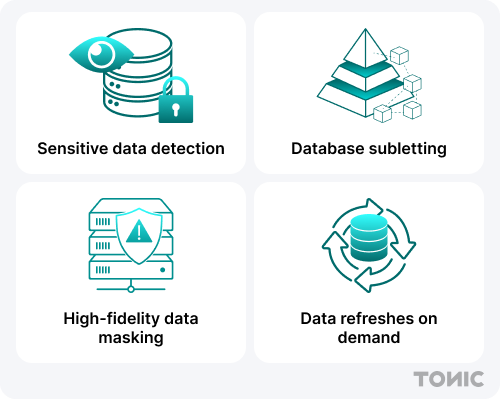
A centralized approach to test data management doesn't mean "one giant database." It means one control plane for how test data is requested, transformed, validated, and delivered. You want a single versioned configuration that defines which sources feed which environments, what transformations apply, and what "done" means—integrity plus utility checks.
Implement deterministic masking
Deterministic masking lets you regenerate the same masked identifiers across refreshes, which keeps fixtures stable and makes bugs reproducible. Use format-preserving techniques where downstream systems validate shape—length, charset, check digits, for example. Pair that with referential integrity checks—foreign keys, join cardinalities, and "no orphan rows" assertions so you catch inconsistencies before your test suite does.
Leverage database subsetting
Full copies are slow, expensive, and often unnecessary. Subsetting gives you smaller datasets that still behave like production for the workflows you're testing. Start with "root" entities—customers, accounts, tenants—and pull a relationship-closed slice: all dependent rows needed for end-to-end flows (orders, payments, tickets, events). Then, validate that critical queries still return representative results with distribution and correlation checks, plus targeted regression tests.
Use agentic AI to fill data gaps
Even with robust data masking and subsetting, you'll hit gaps: rare edge cases, missing combinations, or stateful sequences that don't exist in your test data slice. Synthetic data generation complements a masking and subsetting strategy.
Tonic Fabricate can help you fill in the gaps by generating synthetic structured datasets from scratch while respecting schema, relationships, and a realistic statistical shape—no production records required. Fabricate's Data Agent makes this workflow fast: tell the Data Agent what you need, iterate in the chat, and get the data you need.
Get the test data solution built for today's developers.
Accelerate your release cycles and eliminate bugs in production with safe, high-fidelity data generation.
Implementation blueprint for syncing disparate systems
Here’s a look at a concrete, repeatable sequence you can implement. The goal is to keep schema alignment and cross-database consistency as first-class requirements—not best-effort cleanup after tests fail.
Step 1: Map the ecosystem
Inventory every source that feeds tests, including "side channels" like exported CSVs, Kafka topics saved to object storage, and application logs. Classify each by structured (RDBMS, warehouse tables), semi-structured (JSON/Avro/Parquet with evolving schemas), or unstructured (logs, tickets, emails, documents).
Then document join keys and identity surfaces: customer identifiers, account numbers, email addresses, device IDs—anything that must remain consistent across systems. This becomes your consistency contract.
Step 2: Establish cross-database consistency
Pick a small set of canonical transformations for identifiers and apply them everywhere those identifiers appear—tables, event payloads, and text. Combine deterministic masking for stable ID mapping across sources with format-preserving encryption where strict formatting rules exist.
If you're using the Tonic platform, a key workflow is setting a consistency seed between Tonic Structural (structured de-identification) and Tonic Textual (unstructured entity detection and redaction) so the same source identifier maps consistently across both systems. Treat the seed/config as a controlled secret: version it, restrict access, and rotate when policy requires.
Step 3: Orchestrate with CI/CD
Trigger refreshes on schema changes (migrations merged), scheduled cadence (nightly/weekly), or on-demand requests (per-branch test environments). Publish datasets as artifacts with clear version tags, and gate promotion on automated validation—integrity, utility, and privacy checks. This prevents "works on my dataset" drift and keeps multi-team test environments coherent.
Why teams trust Tonic.ai for multi-source TDM
To manage test data from multiple sources, you need three things to stay true at the same time: identifiers remain consistent across systems, schemas stay aligned as teams ship, and sensitive values don't sprawl into places they shouldn't. Most teams fail when they treat these as separate problems owned by different groups.
Tonic.ai is key to a unified approach.
- Tonic Structural de-identifies structured and semi-structured data while preserving relationships and referential integrity across complex foreign keys.
- Tonic Textual detects and redacts sensitive entities in unstructured text and synthesizes realistic replacements—useful when identifiers and PII leak into logs, tickets, and notes.
- Tonic Fabricate generates synthetic datasets from scratch, handy when you need new scenarios, dense edge cases, or safe sandboxes without production records.
If you implement the blueprint above, you'll spend less time debugging test-data issues that masquerade as app bugs and more time shipping.
Want to see how this looks in your environment? Book a demo with Tonic.ai to walk through a multi-source TDM workflow end-to-end.